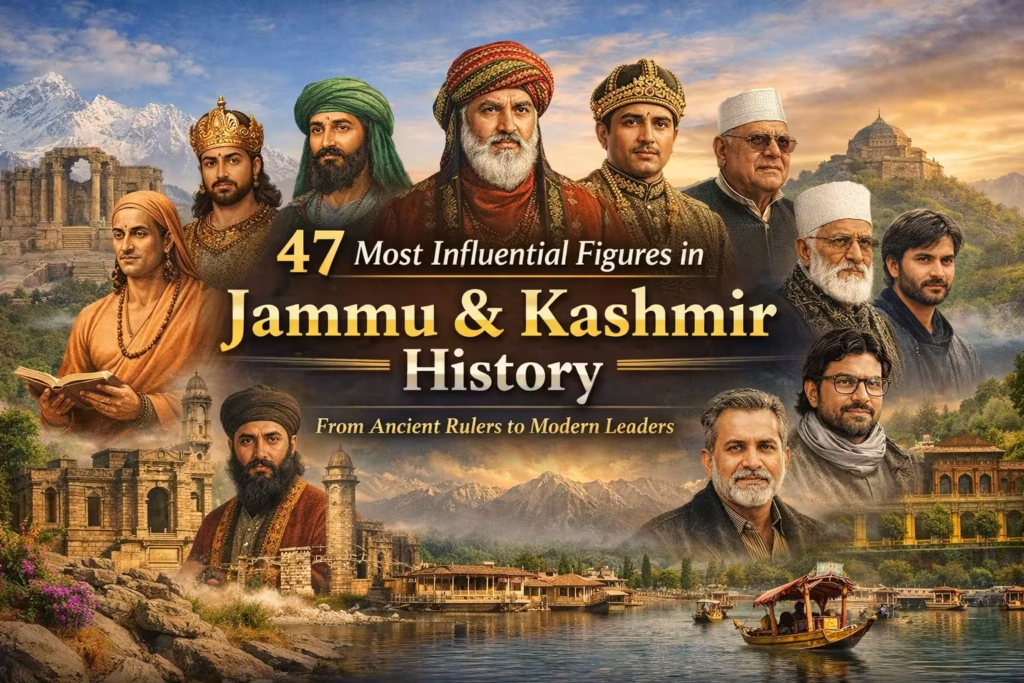
Jammu & Kashmir has never been shaped by one story—or one type of leader. Its identity comes from ancient scholars, saints and reformers, sultans and emperors, Dogra-era state builders, and modern political voices who influenced how people think, live, write, and resist.
This blog lists 47 influential figures connected to the region’s history (Kashmir Valley, Jammu, and Ladakh) and explains—in one short paragraph each—why they matter.
Ancient & Early Medieval Foundations (Before the 14th Century)
1) Kalhana
Kalhana is Kashmir’s most important early historian, famous for writing the Rajatarangini—a chronicle of Kashmiri kings that preserves political history, court culture, and dynastic change, and remains one of the strongest historical anchors for early Kashmir.
2) Lalitaditya Muktapida
Often remembered as one of Kashmir’s most powerful ancient rulers, Lalitaditya symbolizes the Karkota dynasty’s peak—an era linked with strong state power, cultural patronage, and architectural legacy associated with classical Kashmir.
3) Ashoka
Ashoka’s influence in Kashmir is mainly tied to Buddhism’s spread across the northwest; his empire’s patronage helped Buddhist institutions and ideas travel through regions connected with Kashmir’s early religious and cultural landscape.
4) Meghavahana
Meghavahana is remembered in Kashmiri historical tradition as a ruler associated with ethical kingship, especially stories that emphasize compassion and non-violence—an image that shaped later ideals of “just rule.”
5) Avantivarman
Avantivarman is frequently linked with governance reforms and stability in early medieval Kashmir; historical tradition remembers his period for strengthening administration and supporting economic and agrarian well-being.
6) Sangramaraja
A notable Lohara dynasty king, Sangramaraja represents a difficult period of political instability, where succession struggles and internal pressures tested Kashmir’s ability to maintain long-term order.
7) Durlabhavardhana
Often treated as a foundational figure in dynastic transition narratives, Durlabhavardhana symbolizes the kind of ruler who consolidates authority during shifting political eras and lays groundwork for later state continuity.
8) Kshemendra
Kshemendra was a major Sanskrit writer from Kashmir whose works preserve cultural life through satire, moral commentary, and storytelling—helping modern readers understand how society thought, behaved, and debated.
9) Abhinavagupta
Abhinavagupta stands among Kashmir’s greatest intellectual figures, shaping Kashmir Shaivism, philosophy, and aesthetics; his ideas influenced spirituality and the theory of art far beyond the region.
10) Somadeva
Somadeva’s name is associated with classical storytelling traditions; his narrative legacy represents Kashmir’s scholarly culture and its role in preserving rich story cycles that traveled across South Asia.
Sultanates, Saints & Social Transformation (14th–16th Century)
11) Shah Mir
Shah Mir founded the Shah Mir dynasty, initiating a major political shift into sultanate governance; his rise marks a turning point that reshaped Kashmir’s political institutions and elite structures.
12) Sikandar Shah Miri
Sikandar remains one of the most debated rulers in Kashmiri memory, often discussed for policies that strongly affected religious and cultural institutions—making his reign a focal point for contested interpretations of medieval change.
13) Zain-ul-Abidin (Budshah)
Zain-ul-Abidin is widely celebrated for a reign linked with cultural patronage and relative tolerance; remembered as a capable ruler, he became an enduring symbol of humane governance in Kashmiri popular memory.
14) Mir Sayyid Ali Hamadani (Shah-e-Hamdan)
A key Sufi scholar and spiritual figure, Hamadani’s influence is tied to Islamic learning and social transformation; traditions credit him with shaping religious life and inspiring craft and artisan culture associated with Kashmir.
15) Sheikh Noor-ud-din Wali (Nund Rishi)
Nund Rishi is central to Kashmir’s Rishi tradition and is among the valley’s most beloved saints; his teachings shaped everyday moral values and spiritual identity across generations.
16) Yusuf Shah Chak
Yusuf Shah Chak symbolizes the last phase of independent Kashmiri sultanate politics before Mughal dominance; his story is remembered for political struggle, shifting alliances, and the close of a major chapter.
17) Habba Khatoon
Habba Khatoon became a cultural icon through poetry and legend tied to the Chak era; her influence lives most strongly in Kashmir’s emotional memory, language, and folk imagination.
Mughal, Afghan & Sikh Control (1586–1846)
18) Akbar
Akbar’s annexation of Kashmir brought the region into the Mughal imperial system, altering governance, taxation, and elite culture while linking Kashmir’s political fate to broader north Indian power centers.
19) Jahangir
Jahangir deeply shaped Kashmir’s image in imperial imagination; his era strengthened the valley’s reputation as a symbol of beauty and retreat, influencing travel narratives and Mughal cultural identity.
20) Shah Jahan
Associated with peak Mughal aesthetic taste, Shah Jahan’s influence is reflected in the wider imperial culture that shaped architecture and garden traditions connected to Kashmir’s refined artistic reputation.
21) Aurangzeb
Aurangzeb’s reign is often associated with more rigid political climates across the empire; in Kashmir’s history, his era is discussed in relation to governance priorities and shifting imperial attitudes.
22) Ahmad Shah Durrani
Durrani’s influence connects to Afghan rule periods remembered for hardship and instability in many regional narratives; his empire’s reach shaped Kashmir’s trajectory before the Sikh takeover.
23) Ranjit Singh
Ranjit Singh’s Sikh empire brought Kashmir under Lahore-centered politics, changing administration and power structures—making his rule a major turning point before the Dogra state emerged.
24) Jabbar Khan
Jabbar Khan symbolizes the Afghan governor era in Kashmir’s historical memory, often connected to stories of strict authority and the social pressures that shaped everyday life under Afghan administration.
Dogra Rule & State-Building (1846–1947)
25) Gulab Singh
Gulab Singh founded the princely state of Jammu & Kashmir in 1846 after the Amritsar Treaty, creating the political unit that defined the region’s borders and governance until 1947 and shaped modern disputes and identities.
26) Ranbir Singh
Ranbir Singh is linked with consolidation and reform within the Dogra administration; his era is often remembered for strengthening state systems and formal governance structures.
27) Pratap Singh
Pratap Singh’s reign unfolded under British paramountcy, making it a politically sensitive period where internal decision-making was shaped by external supervision—leaving long-term consequences for the state’s politics.
28) Hari Singh
As the last ruling Maharaja, Hari Singh stands at the center of the 1947 transition and accession crisis; his decisions and delays became historically pivotal in shaping the region’s post-partition trajectory.
29) Zorawar Singh
Zorawar Singh is remembered as a bold Dogra general whose high-altitude campaigns expanded Dogra influence into frontier regions, making him a defining figure in Ladakh-connected strategic history.
30) Prem Nath Bazaz
Bazaz was an influential journalist and intellectual who shaped modern Kashmiri political thought through writing and advocacy, helping define debates about rights, identity, and future direction in the 20th century.
31) Sheikh Abdullah
Sheikh Abdullah became the most defining political leader of modern Kashmir’s mainstream politics, shaping mass mobilization, governance narratives, and center-state relations across decades of change.
Post-1947 Politics, Movements & Public Life
32) Farooq Abdullah
Farooq Abdullah carried forward the Abdullah legacy and shaped electoral politics for decades; his leadership influenced Kashmir’s mainstream political landscape through periods of conflict, negotiation, and shifting public sentiment.
33) Omar Abdullah
Omar Abdullah emerged as a modern-generation leader navigating conflict-era governance, public trust challenges, and evolving relations between regional politics and national-level decision-making.
34) Mufti Mohammad Sayeed
Mufti Sayeed reshaped the region’s political equation through party-building and coalition strategy, influencing how governance could be formed and negotiated in Jammu & Kashmir’s complex democratic environment.
35) Bakshi Ghulam Mohammad
Bakshi Ghulam Mohammad represents a key early post-1953 era, remembered for development-driven governance narratives and also for intense debate over legitimacy and political alignment with New Delhi.
36) Ghulam Mohammad Sadiq
Sadiq is remembered for political and administrative restructuring, with emphasis on institutional governance; his era remains significant in understanding mid-to-late 20th-century state evolution.
37) Syed Ali Shah Geelani
Geelani was a major voice in separatist politics, shaping protest culture and ideological framing around self-determination debates, and influencing public discourse for decades.
38) Mirwaiz Umar Farooq
A religious and political figure, Mirwaiz Umar Farooq influenced civic life through spiritual authority and political engagement, often associated with dialogue-oriented strands in Kashmiri politics.
39) Maqbool Bhat
Maqbool Bhat became a powerful symbol in Kashmiri nationalist narratives, remembered for shaping militant-era imagination and political symbolism that continues to evoke strong reactions.
40) Yasin Malik
Yasin Malik influenced modern Kashmir’s political evolution through activism that crossed phases of armed struggle and later political engagement, becoming a widely recognized figure in contemporary history.
41) Sajjad Gani Lone
Sajjad Lone represents contemporary politics shaped by legacy and shifting alliances; his role reflects how modern leadership navigates regional representation, coalition realities, and public expectations.
Literature, Spiritual Thought & Cultural Identity (Modern Era)
42) Agha Shahid Ali
Agha Shahid Ali carried Kashmir’s memory, grief, and beauty into global literature; his poetry helped the world emotionally understand Kashmir beyond headlines and conflict language.
43) Rehman Rahi
Rehman Rahi is one of the most significant modern Kashmiri poets, shaping language pride and cultural identity through influential writing that kept Kashmiri expression powerful in public life.
44) Ghulam Ahmad Mahjoor
Mahjoor’s poetry became deeply popular and emotionally resonant; he helped define modern Kashmiri poetic voice and its relationship with society, identity, and collective feeling.
45) Dina Nath Nadim
Nadim played an important role in Kashmiri literary modernism, shaping how Kashmiri poetry adapted to new political realities and changing social consciousness.
46) Muhammad Iqbal (Allama Iqbal)
Though not a Kashmiri ruler, Iqbal’s philosophical poetry influenced South Asian Muslim political thought—including how many Kashmiris conceptualized identity, awakening, and political destiny in the 20th century.
47) Muhammad Yusuf Taing
A respected historian and academic, Yusuf Taing influenced how Kashmir’s past is studied and taught, contributing to modern historical understanding of the region’s complex political and cultural evolution.
Why These 47 Names Still Matter
Jammu & Kashmir’s story is not just a timeline of rulers—it’s a layered history of ideas, faith, art, power, and public struggle. These 47 figures shaped institutions, culture, identity, and politics across centuries. Whether you see them as heroes, reformers, controversial leaders, or symbols of an era, their influence still echoes in how Kashmir, Jammu, and Ladakh remember themselves today.
You may also like
-
Indian Government Revokes Professor Nitasha Kaul’s Overseas Citizenship
-
The History of India-Pakistan Wars: Conflicts, Causes, and Outcomes (1947–2025)
-
Zain-ul-Abidin (Budshah) – Most Benevolent Medieval King Of Kashmir
-
5 January Resolution: A Conditional trap for Kashmiris
-
The History of Azad Jammu and Kashmir (AJK)