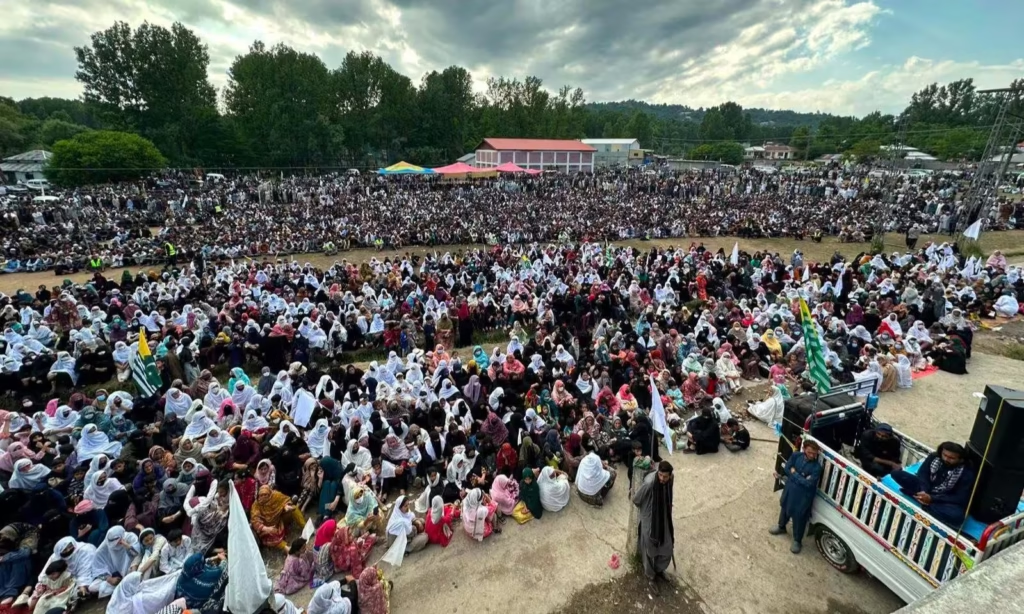
JAAC Says Two Protesters Killed in Dadyal Clashes as Rights Concerns Deepen in AJK
DADYAL / MIRPUR, July 7, 2026: The Joint Awami Action Committee-linked protest leadership has accused security forces of killing two demonstrators during fresh clashes in Dadyal tehsil of Mirpur district, a claim rejected by the AJK police chief even as rights groups and Kashmiri voices continue to raise alarm over the widening crackdown on the movement.
According to Arab News, Liaqat Hayat, a National Awami Party member associated with the JAAC sit-in in Rawalakot, said the violence on Sunday was confined to Dadyal, where two protesters were killed and three others injured. He said there had been no clash in Rawalakot despite a large turnout at the sit-in, which he estimated at around 60,000 people, including women.
Hayat identified the casualties as civilians and said the JAAC-linked protest leadership had no verified information about police casualties. He maintained that, according to the reports available to the movement, the casualties were from among protesters and ordinary civilians.
AJK Inspector-General of Police Liaqat Ali Malik denied the reported civilian deaths and described the claims as “information warfare,” saying any allegation of deaths should be supported by hospital records and post-mortem evidence. Arab News said it could not independently verify the conflicting accounts, while authorities had not released an official casualty figure for the Dadyal incident at the time of reporting.
For Kashmiri civil society, however, the Dadyal incident has become part of a larger pattern: the criminalisation of a public movement that began around economic rights, governance, political representation and local dignity. Amnesty International has described the Jammu Kashmir Joint Awami Action Committee as a grassroots movement advocating for the economic and political rights of people in Pakistan-administered Jammu and Kashmir.
The movement has been protesting the 12 seats in the AJK Legislative Assembly reserved for refugees from Indian-administered Kashmir who live in Pakistan. JAAC argues that these seats give political influence to people who do not reside in AJK and should be abolished so that representation reflects the will of people living in the territory. Al Jazeera reported that the dispute is also tied to deeper questions of governance, political representation, resource allocation and regional autonomy.
The AJK government proscribed JAAC under anti-terror laws in early June, a move that has drawn sharp criticism from rights advocates. Amnesty International called the terrorism designation of the protest movement a “dangerous escalation” and said the crackdown included internet shutdowns, mass arrests and deadly use of force. The rights group said the proscription was “disproportionate” and violated freedom of association.
Reuters reported last month that towns across Pakistan-administered Kashmir were brought to a standstill after a strike called by the recently banned civil society alliance, with streets deserted in Muzaffarabad and other areas. Reuters also reported that the authorities ordered sedition cases against prominent JAAC leaders and announced a reward for their arrest after banning the group.
The Associated Press reported that businesses and public transport were halted across the region after JAAC’s strike call, while residents said markets and bus terminals were largely empty. The report also noted that thousands of supporters had gathered in Mirpur to join the planned mobilisation toward Rawalakot and Muzaffarabad.
The state’s response has also triggered concern among Kashmiris abroad. A motion tabled in the UK Parliament expressed grave concern over reports of a communications blackout, lockdown measures, mass arrests and raids in Azad Jammu and Kashmir. It also called for the protection of peaceful assemblies, safe medical access for injured persons, due process for detainees and the resumption of dialogue with respect for Kashmiri human rights.
JAAC representatives have denied government allegations that the movement is violent, accusing the authorities instead of using force against peaceful demonstrators. In the latest Dadyal dispute, protest figures say civilians were targeted, while the police chief claims protesters fired first. With independent verification still limited, the absence of a transparent, credible and publicly trusted inquiry has further deepened public mistrust.
Hayat also accused the government of refusing meaningful dialogue, saying no serious negotiation mechanism had been formed since early June. He said that if the government appointed representatives, talks could begin quickly.
The Dadyal clashes have now added urgency to JAAC’s demand for negotiations before the situation moves toward another major confrontation. Protest leaders have warned of further action if the government does not engage seriously, while residents across parts of AJK continue to face fear, uncertainty, transport disruption and political tension.
For many Kashmiris, the issue is no longer limited to one clash or one disputed casualty figure. It has become a question of whether a civil rights movement rooted in local grievances will be treated as a political voice to be heard or as a security threat to be crushed.
As of Tuesday, the claim that two protesters were killed in Dadyal remains disputed. But the demand from Kashmiri civil society is clear: the truth must be established through an independent investigation, the injured must have safe access to medical care, detainees must receive due process, and the political crisis must be resolved through dialogue rather than repression.
You may also like
-
Shaukat Nawaz Mir Yet to Be Produced Before Court, Family Denied Access Since Arrest, JKJAAC Says
-
PML-N Leads PaJK Elections Amid Boycott, Rigging Allegations, Violence and Major Political Upsets
-
Muzaffarabad Shuts Down as Clashes and Roadblocks Disrupt Election-Day Movement
-
Civilian Death Toll in PaJK Protests Rises Above 87 as Two More Killed
-
At Least 37 Civilians Killed by Pakistani Security Forces in PaJK in Two Days