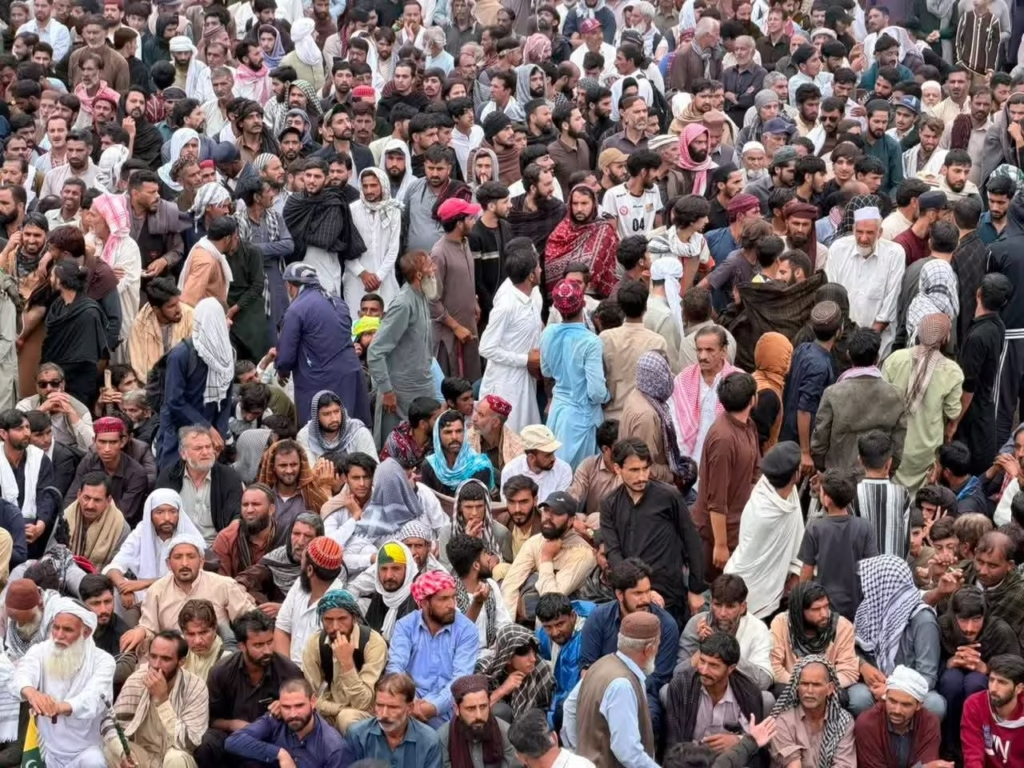
DARAK, POONCH: Negotiations between representatives of the Jammu Kashmir Joint Awami Action Committee and the authorities have made positive progress, but none of the proposed commitments has yet been formally accepted in writing, JAAC leader Umar Nazir Kashmiri told protesters at the continuing sit-in in Darak.
Addressing a gathering at the Darak Eidgah protest camp, Kashmiri said the coming hours would determine whether the discussions produce a written and enforceable agreement.
“There has been positive progress in the negotiations, but nothing has yet been accepted in writing,” he said. “If anyone attempts to deceive us, we will announce the long march at that very moment.”
He urged residents across Pakistan-administered Jammu and Kashmir to remain prepared for further instructions, saying the position would become clearer within a few hours.
The statement reflects continuing uncertainty despite reports of progress in talks. Protest leaders have repeatedly said that verbal assurances will not be sufficient and that the movement will evaluate any settlement on the basis of a written agreement, a clear implementation timetable and practical government action.
Sit-ins Continue After More Than Six Weeks of Unrest
The Darak gathering forms part of a wider network of sit-ins that emerged during the protest movement surrounding the JAAC-called shutdown of June 9. By late July, the unrest and associated protest camps had continued for more than six weeks, although the intensity and location of demonstrations have changed during that period.
Thousands of JAAC supporters established protest camps and road blockades in and around Rawalakot and other areas after deadly confrontations in early June. Reuters reported on June 19 that supporters had gathered on the outskirts of Rawalakot and that the territory-wide unrest had by then continued for nearly two weeks.
The movement later expanded through sit-ins in Poonch, Mirpur and other districts. Protest leaders temporarily postponed a planned long march following back-channel negotiations but made clear that the sit-ins would remain in place while the government was given an opportunity to fulfil the commitments discussed during talks.
Umar Nazir Kashmiri previously announced that the march had been deferred for one week while negotiations continued, expressing hope that matters accepted in principle would be formally settled.
His latest remarks at Darak suggest that the negotiating process has reached a decisive stage but has not yet produced the written settlement demanded by the protest leadership.
Deadly Background to the Negotiations
The talks are taking place against the backdrop of one of the deadliest periods of political unrest in Pakistan-administered Jammu and Kashmir in recent years.
Reuters reported that at least 24 people, including 20 civilians and four police officers, had been killed during approximately two weeks of protests by June 19. The report also said more than 500 people had been detained and dozens of police officers injured.
Further violence occurred in July. On July 14, Reuters reported that another nine people, seven protesters or civilians and two members of the security forces, were killed in clashes in Tararkhal and Rawalakot. The agency cited local estimates placing the overall number of deaths connected with the unrest at around 30 since June.
Casualty figures remain disputed. Government officials, police representatives, protest organisers and local activists have issued differing totals, and restrictions on communications and media access have made independent verification difficult. Higher figures circulated by movement-linked sources should therefore be treated as activist estimates unless supported by independently verified records.
Representation Dispute at Centre of Movement
The immediate political dispute centres on the 12 Legislative Assembly seats reserved for refugees from Indian-administered Jammu and Kashmir who live in Pakistan.
JAAC argues that lawmakers elected from constituencies located outside Pakistan-administered Jammu and Kashmir can influence the formation of the regional government despite not being directly accountable to residents living within the territory.
The regional Supreme Court has ruled that the seats are constitutionally protected and cannot be removed without a constitutional amendment. The government has cited that ruling in arguing that the issue cannot be resolved through an administrative order alone.
The protest movement has also raised demands concerning governance, implementation of previous agreements, official privileges, political representation, the treatment of detainees and accountability for deaths and injuries during security operations.
Written Commitments Remain the Key Test
JAAC leaders have maintained that any settlement must include written commitments rather than verbal assurances. Their position follows earlier agreements in which protesters say implementation was incomplete or delayed.
Kashmiri’s warning indicates that the long march remains an active option rather than a cancelled programme. Any call would likely remobilise protesters across several districts and could again increase pressure on the administration.
The leadership has asked participants to remain at the sit-ins and await a final announcement. At the time of publication, neither the government nor the negotiating delegation had released the complete text of a written agreement confirming which demands had been accepted.
The next few hours are therefore expected to determine whether the negotiations move toward a formal settlement or whether JAAC revives its call for a long march.
You may also like
-
The National Liberation Front: Origins of the Organised Armed Struggle for an Independent Kashmir
-
Shaukat Nawaz Mir Yet to Be Produced Before Court, Family Denied Access Since Arrest, JKJAAC Says
-
PML-N Leads PaJK Elections Amid Boycott, Rigging Allegations, Violence and Major Political Upsets
-
Muzaffarabad Shuts Down as Clashes and Roadblocks Disrupt Election-Day Movement
-
Civilian Death Toll in PaJK Protests Rises Above 87 as Two More Killed