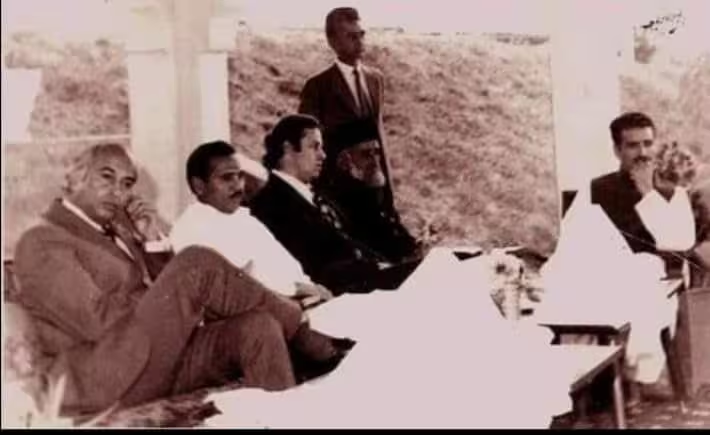

How Maqbool Butt, Amanullah Khan and their associates created an underground movement independent of India and Pakistan, and how arrests, internal weaknesses and the Ganga hijacking dismantled its first organisational network
By Kashmiriat Research Desk
On August 13, 1965, four Kashmiri nationalists reportedly met secretly at the Peshawar residence of a former soldier known as Major Amanullah. Their purpose was to establish an underground organisation prepared to use political mobilisation and armed resistance to change the future of Jammu and Kashmir.
The organisation became known as the Jammu Kashmir National Liberation Front, or simply the National Liberation Front – NLF.
Its founding figures were Maqbool Butt, Amanullah Khan, Mir Abdul Qayyum and Major Amanullah. They did not seek Jammu and Kashmir’s accession to Pakistan, nor did they accept its incorporation into India. Their objective was the reunification of the former princely state and the recognition of its people as the sole authority entitled to decide its political future.
The NLF occupies a complicated place in Kashmir’s history. Supporters remember it as one of the first organised attempts to develop an armed struggle independent of both India and Pakistan. Indian accounts generally describe it as an infiltrating militant organisation operating from Pakistani territory. Pakistani authorities initially tolerated some of its activities but later arrested its leadership and accused it of collaborating with Indian intelligence.
Its history has also been overshadowed by the organisation that inherited much of its ideology: the Jammu Kashmir Liberation Front, established in Britain during the 1970s.
To understand the emergence of the JKLF, the Ganga hijacking and Maqbool Butt’s later political trajectory, it is first necessary to reconstruct what the National Liberation Front was, why it was created and why its first organisational experiment failed.
The political movement behind the NLF
The NLF emerged from the Azad Kashmir Plebiscite Front, also known as Mahaz-i-Raishumari.
The Plebiscite Front was established in 1965 by political activists including Abdul Khaliq Ansari, Amanullah Khan and Maqbool Butt. Ansari became its president, Amanullah Khan its general secretary and Butt its publicity secretary. It advocated the reunification of the former princely state and demanded a plebiscite that included independence alongside accession to India or Pakistan.
The Front was a public political organisation. It intended to mobilise voters, organise conventions, issue political statements and challenge the control exercised by India and Pakistan over their respective parts of Jammu and Kashmir.
Inside the organisation, however, disagreement soon developed over whether public political activity was sufficient.
Maqbool Butt and Amanullah Khan believed the promised plebiscite was becoming an empty diplomatic slogan. India was consolidating its control over the territory under its administration, while Pakistan continued to define self-determination primarily as accession to Pakistan. Neither state accepted the emergence of an independent Kashmiri political authority.
The success of anti-colonial struggles in Algeria and the resistance movements in Vietnam and Palestine influenced the younger Kashmiri nationalists. These movements appeared to demonstrate that diplomacy alone rarely compelled powerful states to surrender territory. Victoria Schofield records that Algeria and Vietnam particularly influenced activists in exile, while Butt later described his preference for an Algerian-style struggle.
The proposal rejected by the Plebiscite Front
According to accounts attributed to Amanullah Khan, a proposal to make armed struggle part of the Plebiscite Front’s official programme was presented at a working-party meeting in Mirpur on July 12, 1965.
The proposal was rejected.
Senior members feared that underground activity would expose the entire political movement to prosecution. Others believed that an armed campaign conducted without broad public support, resources or an internationally protected base would be premature.
Butt, Amanullah Khan and their associates proceeded despite the rejection. On August 13, they reportedly established the NLF in secret at Major Amanullah’s home in Peshawar.
This history makes the NLF’s relationship with the Plebiscite Front more complicated than the familiar description of it as the Front’s “armed wing.”
It shared founders, members and political objectives with the Plebiscite Front. However, the parent organisation had not formally approved its establishment. The NLF was therefore better understood as an underground offshoot operating within and around the Plebiscite Front’s political network, rather than a military department authorised by the Front’s full leadership.
That distinction later became important when underground operations brought arrests and political pressure upon members who had not participated in planning them.
The founding leadership
The available accounts identify four principal founders.
Maqbool Butt
Maqbool Butt assumed the leading coordinating role.
He had migrated from the Kashmir Valley to Pakistan in 1958, worked as a journalist in Peshawar and won a seat representing Kashmiri refugees in the 1961 Basic Democracies election. His experience included journalism, electoral campaigning and political organisation among displaced Kashmiris.
Butt’s political position developed beyond the traditional pro-Pakistan framework. He came to believe that Kashmiris had to organise their struggle independently rather than wait for Pakistan to liberate the territory or for the United Nations to implement a plebiscite.
Amanullah Khan
Amanullah Khan had already established the Kashmir Independence Committee and published material advocating the reunification and complete independence of Jammu and Kashmir.
He became one of the NLF’s principal political organisers and later built its international and diaspora networks. His political importance would grow further after his migration to Britain, where he helped transform the movement into the JKLF.
Mir Abdul Qayyum
Mir Abdul Qayyum was a Jammu-origin Kashmiri settled in Pakistan and associated with the Plebiscite Front. Later accounts describe him as involved in the political and financial work of the underground organisation.
Major Amanullah
Major Amanullah, distinct from Amanullah Khan, was a former soldier associated with Highhama in the Kashmir Valley. Movement histories describe him as having served in Subhas Chandra Bose’s Indian National Army and later participated in the 1947 conflict in Kashmir.
His military background gave him responsibility for the NLF’s armed and organisational work, and his Peshawar home reportedly became the location of its founding meeting. These biographical details largely survive through activist accounts and require confirmation from military and personal records.
What did the NLF seek to achieve?
The NLF’s stated objective was not simply to remove Indian forces from the Kashmir Valley.
Its programme referred to the people of the entire former state of Jammu and Kashmir as the owners of the territory and sought to create conditions in which they could determine its future. The organisation endorsed “all forms of struggle,” explicitly including armed resistance.
This position distinguished the NLF from organisations working for Kashmir’s accession to Pakistan.
For the NLF, the ceasefire line did not divide two legally separate countries. It divided one political homeland. Its conception of Jammu and Kashmir included the Valley, Jammu, Ladakh, Azad Kashmir and the territories now called Gilgit-Baltistan.
Historian Shahla Hussain argues that Butt and his associates understood freedom as the reunification of the historical state rather than simply the opportunity to select India or Pakistan. Their actions challenged the permanence of the ceasefire line and the exclusive authority claimed by both states.
The NLF was therefore a territorial nationalist movement. It presented Kashmiris as a political people distinct from the strategic interests of India and Pakistan.
This position also created the organisation’s central vulnerability. It had no state sponsor fully committed to its ultimate objective. Pakistan might tolerate activity directed against India, but it could not comfortably support a movement that also rejected Pakistan’s claim to the territory under its administration.
Building an underground network
For approximately ten months after its formation, the NLF concentrated on recruitment and the creation of an underground structure.
Movement accounts state that it recruited activists from Azad Kashmir and among Kashmiri refugees living elsewhere in Pakistan. Some members possessed political experience, while others had served in the military or maintained family and community contacts across the ceasefire line.
Later histories divide the organisation’s work into political, financial and operational responsibilities. Maqbool Butt was responsible for overall coordination, while Amanullah Khan, Mir Abdul Qayyum and Major Amanullah performed different organisational roles.
The precise membership, financing and command structure remain unclear.
No authenticated membership register, founding constitution, financial ledger or complete set of internal communications has been placed in a public archive. Much of what is known comes from autobiographies, interviews, movement publications and later histories written by supporters or opponents.
It is therefore difficult to establish how large the NLF became before its first operation. Descriptions of a rapidly expanding network may reflect genuine recruitment, but they may also have been enlarged by later political memory.
The first crossing in 1966
On June 10, 1966, the NLF sent its first organised group across the ceasefire line into Indian-administered Jammu and Kashmir.
The principal group included Maqbool Butt, Tahir Aurangzeb, a student from Gilgit, Amir or Mir Ahmad, and Kala Khan, a former non-commissioned officer associated with the AJK forces. Other members remained nearer the dividing line to maintain contact and provide support.
The group’s immediate purpose was organisational rather than the launching of a widespread military campaign. It sought to recruit local supporters, create underground cells and establish a network capable of sustaining future resistance.
Schofield records that Butt remained in the Valley for about four months, training local workers for sabotage and establishing secret cells. Movement accounts describe recruitment efforts in and around Srinagar, Sopore, Handwara and Kupwara.
The mission revealed both the ambition and the weakness of the new organisation.
The NLF had succeeded in crossing the military divide and making contact with potential supporters. But it had no secure territorial base, limited resources and weak mechanisms for verifying recruits. Its underground cells were vulnerable to informants and surveillance.
The Kunial or Kanila confrontation
In September 1966, Indian security forces located members of the NLF in a village near Handwara, variously written as Kunial, Kanila or Kunyal in later sources.
The confrontation followed the detention of a police or intelligence officer named Amar Chand. Available accounts state that Amar Chand and at least one NLF member were killed, while Butt and other members of the group were captured.
The precise sequence remains disputed.
Some accounts say Tahir Aurangzeb was killed and that Butt, Kala Khan and Amir Ahmad were arrested. Other summaries claim that Kala Khan died and Butt and Mir Ahmad were captured. Schofield avoids naming the NLF member, recording only that one of Butt’s associates and an Indian officer were killed.
This disagreement demonstrates the need for the original police report, post-mortem records and court judgment.
It is also disputed whether Amar Chand was deliberately abducted and killed, died while attempting to escape or was killed during the exchange of fire. Indian authorities prosecuted Butt and his associates for murder and sabotage. Movement supporters maintained that the confrontation occurred before the NLF had completed its organisational preparations.
Whatever the precise sequence, the incident ended the NLF’s first underground mission and exposed its existence to Indian authorities.
Arrests and the first NLF trial
The authorities detained Maqbool Butt and surviving members of the group and launched a wider operation against their suspected contacts.
Movement accounts claim that approximately 300 people were arrested, including students, traders, engineers, teachers and members of several political parties. The number has not been independently verified through official detention records.
Butt and his associates were tried for crossing the ceasefire line, sabotage and the killing of Amar Chand.
In August or September 1968, Butt and another accused, usually identified as Amir or Mir Ahmad, were sentenced to death. Kala Khan, according to the version in which he survived the confrontation, received a life sentence. Schofield confirms that Butt and another activist received death sentences in September 1968.
Butt did not deny his opposition to Indian authority. His defence was that he was not the agent of India’s foreign enemy, Pakistan, but an opponent of the political system imposed on Kashmir.
That distinction became central to his later trials in both India and Pakistan. Each state attempted to define him through his alleged loyalty to the other. Butt instead presented himself as part of an independent Kashmiri movement rejecting the sovereignty claimed by both.
The Srinagar prison escape
Before the death sentence could be carried out, Butt and two fellow prisoners escaped from Srinagar Central Jail on December 8, 1968.
They reportedly crossed the mountains during winter and reached the Pakistan-administered side later that month. Schofield records that local residents sheltered and guided the escapees before they reached Azad Kashmir.
Movement narratives turned the escape into one of the most celebrated episodes of Butt’s life. It restored his political standing and demonstrated that the NLF had not been completely destroyed by the 1966 arrests.
But the reception awaiting him on the Pakistan-administered side revealed the contradiction at the centre of the movement.
Rather than immediately accepting him as a returning freedom fighter, Pakistani or AJK authorities detained and interrogated Butt and his companions. Butt later alleged that he was tortured during this detention. The men were reportedly released in March 1969 after protests by the Plebiscite Front, NLF and National Students Federation.
The episode showed that crossing the ceasefire line was considered an unauthorised act by both India and Pakistan. A Kashmiri nationalist could be prosecuted by India for entering the Valley and detained by Pakistan after escaping from Indian custody.
Reorganisation after Butt’s return
After his release, Butt resumed public and underground political activity.
He was elected president of the Plebiscite Front at its 1969 convention in Muzaffarabad, according to movement accounts. The Front campaigned against political restrictions in Azad Kashmir and the direct administration of Gilgit-Baltistan by Pakistan. Its activists also opposed constitutional arrangements they believed separated the Pakistan-administered territories from the rest of the former state.
The NLF, meanwhile, attempted to rebuild its network.
It attracted younger activists who regarded Butt’s prison escape as evidence that active resistance could challenge the status quo. Among those associated with the organisation was Hashim Qureshi, who later became the central figure in the 1971 Ganga hijacking.
The movement still faced serious limitations. It lacked stable financing, reliable communications and secure territory. Its public and underground branches overlapped, creating the risk that the exposure of one would endanger the other.
These weaknesses became disastrous after Ganga.
The Ganga hijacking
On January 30, 1971, Hashim Qureshi and Ashraf Qureshi diverted an Indian Airlines aircraft named Ganga from its Srinagar–Jammu route to Lahore.
The hijackers identified themselves with the National Liberation Front and demanded the release of Kashmiri political prisoners held by India. Passengers and crew were eventually released, and the aircraft was destroyed on February 2. A contemporary United States diplomatic record identifies the hijackers as NLF members and records their demand for the release of political prisoners.
Maqbool Butt publicly accepted political responsibility on behalf of the movement after the aircraft arrived in Lahore. Pakistan initially permitted public celebrations, and the hijackers were presented as Kashmiri freedom fighters.
India then banned Pakistani aircraft from flying over Indian territory. The decision created a major logistical problem for Pakistan because its eastern and western wings were geographically separated.
Pakistan subsequently reversed its position. The hijacking was declared an Indian intelligence conspiracy, and the same activists who had initially been celebrated were arrested and prosecuted.
The crackdown after Ganga
The arrests extended far beyond Hashim and Ashraf Qureshi.
Pakistani authorities detained Maqbool Butt, G. M. Lone, Mir Abdul Qayyum and other members and supporters of the NLF and Plebiscite Front. Accounts differ considerably over the number arrested, ranging from approximately 150 to several hundred.
Detainees later alleged that they were held at interrogation centres including Lahore’s Shahi Qila and camps in the Muzaffarabad region. They claimed that officials attempted to force them to admit that the hijacking had been planned by Indian intelligence.
Six principal defendants were eventually prosecuted before a special tribunal in Pakistan, according to the available movement and newspaper accounts.
The prosecution sought to prove that the hijacking was not an independent NLF operation but part of an Indian conspiracy against Pakistan. Most defendants, including Butt, were cleared of the central allegation that they had acted as Indian agents. Hashim Qureshi remained imprisoned, although secondary sources disagree over the precise sentence imposed.
The verdict did not restore the NLF.
Its leaders had spent years detained or under investigation. Its membership had been exposed. Supporters feared further arrests, and accusations of infiltration created mistrust inside the organisation.
The state failed to prove that the NLF leadership was controlled by India, but the crackdown succeeded in dismantling much of its organisational capacity.
Was the NLF controlled by Pakistan?
India consistently viewed the NLF’s cross-ceasefire-line activities as evidence of Pakistani sponsorship.
The organisation was founded and recruited on territory administered by Pakistan. Some members had military backgrounds, and later accounts suggest that individuals within the AJK bureaucracy or security structure may initially have tolerated or assisted its activities.
Those circumstances justify investigation, but they do not establish that the NLF was created or controlled by Pakistan.
Its declared objective contradicted Pakistan’s territorial claim. It sought independence for all of Jammu and Kashmir, including Azad Kashmir and Gilgit-Baltistan. Its political wing criticised Islamabad’s control over AJK, and its leaders were repeatedly detained by Pakistani authorities.
The treatment of the organisation after the Ganga hijacking further demonstrates the limits of any Pakistani support. When the NLF’s actions produced strategic consequences for Pakistan, the state arrested its leadership and accused it of working for India.
The most defensible conclusion is that the NLF may at times have benefited from local tolerance, personal contacts or the expectation that its activities would be directed against India. But it was not politically subordinate to Pakistan, and Islamabad did not accept its ultimate objective.
Was the NLF infiltrated by India?
The Ganga case raised serious questions about Indian penetration of the organisation.
Hashim Qureshi had been detained by India’s Border Security Force before the hijacking and was reportedly released after suggesting that he would cooperate. Pakistan later treated this contact as proof that he had become an Indian agent.
Qureshi maintained that he deceived Indian officials and continued with the NLF operation independently.
No publicly released Indian intelligence order has conclusively demonstrated that the hijacking was planned by New Delhi. Nevertheless, the NLF’s weak security procedures and rapid recruitment made infiltration possible.
The organisation’s first Valley network had already been exposed in 1966, reportedly through an informant. By 1971, intelligence agencies on both sides had strong reasons to penetrate a movement that crossed the ceasefire line and challenged both states.
The NLF therefore operated in an environment in which infiltration was not merely possible but highly likely. What remains unproven is the extent to which either state controlled particular operations.
The 1975 election and the political alternative
After the Ganga trial, Butt and his associates again attempted constitutional politics.
The Plebiscite Front participated in the 1975 AJK Legislative Assembly election, while Butt contested two refugee constituencies. Front members later alleged that the results were manipulated in favour of Zulfikar Ali Bhutto’s Pakistan Peoples Party.
The election was significant because it showed that Butt did not regard armed activity as the movement’s only method. He continued to combine revolutionary organisation with public campaigning and electoral participation.
The NLF, however, had already been severely weakened. Its operational structure had not recovered from the post-Ganga arrests, and the Plebiscite Front lacked the resources and official support enjoyed by Pakistan’s governing party.
The official defeat of all Front candidates further narrowed the space available to the independence movement.
Maqbool Butt’s final crossing
In May 1976, Butt crossed into Indian-administered Kashmir again, accompanied by Abdul Hamid Butt and Riaz Dar.
Movement accounts describe the decision as controversial even among his colleagues. The NLF had been dismantled, the Plebiscite Front was demoralised and several associates advised him not to undertake another mission.
Shortly after entering the Valley, Butt became involved in an attempted bank robbery during which an employee was killed. He was arrested and his earlier death sentence was eventually restored.
His arrest effectively ended the original NLF’s active phase.
Amanullah Khan subsequently concentrated on organising among Kashmiri communities in Britain, where political activity could be conducted beyond the immediate control of India and Pakistan.
From the NLF to the JKLF
In May 1977, activists in Britain established or reorganised the movement under the name Jammu Kashmir Liberation Front.
The exact organisational transition is described differently in different sources.
Some histories state that Amanullah Khan renamed the National Liberation Front because an organisation with armed struggle written into its constitution could not operate openly in Britain. Schofield records Khan making precisely that argument.
Other accounts state more specifically that the British chapter of the Plebiscite Front was transformed into the JKLF, which then inherited the ideology, personnel and historical legacy of both the political Front and the underground NLF.
The two versions are not necessarily irreconcilable.
The JKLF developed from a political network in which the Plebiscite Front and NLF had always overlapped. It preserved the NLF’s objective of an independent, reunited Jammu and Kashmir while initially placing greater emphasis on diaspora mobilisation and international advocacy.
It is nevertheless historically misleading to treat the NLF and JKLF as exactly the same organisation under two interchangeable names. The JKLF emerged in a different political environment, developed a broader international structure and later created its own armed formations.
What did the NLF achieve?
Measured against its declared objective, the NLF did not liberate or reunify Jammu and Kashmir.
Its first underground network was exposed within months. Its leaders were captured, sentenced or detained. The Ganga operation brought publicity but also produced a crackdown that nearly destroyed the organisation. It failed to establish a durable mass structure inside the Valley or a secure political base on the Pakistan-administered side.
Its adoption of armed struggle also carried serious human costs.
The 1966 mission ended with deaths and mass arrests. The Ganga hijacking placed civilian passengers and crew in danger, even though they were released unharmed. Underground activity gave India and Pakistan opportunities to criminalise a wider political movement whose members were not necessarily involved in violence.
Yet the NLF had a significant ideological impact.
It introduced the idea that Kashmiris could organise independently of both India and Pakistan. It treated the ceasefire line as an artificial division rather than a legitimate international border. It presented independence as a political objective to be pursued by Kashmiris themselves, rather than as a concession to be granted by either state.
Its organisational methods failed, but its territorial and nationalist programme survived.
That programme passed into the JKLF and later became one of the principal ideological traditions of the uprising that emerged in the Kashmir Valley at the end of the 1980s.
The missing NLF archive
A complete history of the National Liberation Front cannot yet be written from publicly available records.
The essential missing documents include:
- the NLF’s original constitution and founding declaration;
- minutes of the July 1965 Plebiscite Front meeting;
- membership and financial records;
- correspondence between Maqbool Butt, Amanullah Khan, Mir Abdul Qayyum and Major Amanullah;
- the complete Indian police report on the 1966 crossing;
- the Amar Chand case file and judgment;
- records identifying which NLF member died in the confrontation;
- Butt’s statements during his first Indian trial;
- Pakistani interrogation records following his 1968 escape;
- internal NLF correspondence concerning the Ganga operation;
- the complete Ganga tribunal judgment;
- documentation of the transition from the NLF and Plebiscite Front to the JKLF.
Oral histories should also be collected from surviving members, relatives and residents who sheltered or encountered the early activists.
Such testimony must be tested against contemporary documents. But without it, many of the organisation’s internal debates, particularly disagreements over violence, relations with Pakistan and the planning of operations, may disappear.
An organisation caught between two states
The National Liberation Front emerged from a belief that Kashmiris could not depend upon India, Pakistan or international diplomacy to deliver self-determination.
Its founders concluded that Kashmiris had to become independent political actors, capable of organising across the ceasefire line and defining freedom on their own terms.
That ambition distinguished the NLF from both Indian constitutional politics and Pakistan-backed accession movements. It also ensured that the organisation would eventually face opposition from both states.
India prosecuted its members as infiltrators and enemy agents. Pakistan detained them when their independent activities conflicted with Islamabad’s interests. Each state attempted to interpret the NLF through the other: India presented it as a Pakistani instrument, while Pakistan later presented it as an Indian conspiracy.
Neither interpretation fully explains the movement.
The NLF was an indigenous Kashmiri nationalist organisation, but one with limited resources, weak security and a strategy that exposed both its members and civilians to grave risks. It was neither powerful enough to confront two states nor disciplined enough to prevent infiltration and premature operations.
Its organisational life was brief. Its political legacy was not.
The NLF established the ideological foundation upon which the JKLF was later built: that Jammu and Kashmir constituted one divided country, that neither India nor Pakistan possessed exclusive sovereignty over it, and that Kashmiris themselves had the right to determine its future.
The organisation failed to achieve that objective. But it permanently changed the vocabulary of the Kashmiri struggle by introducing a third political position between India and Pakistan, and by attempting, however unsuccessfully, to organise that position into an independent movement.
Archival source note
This article draws upon Shahla Hussain’s academic study of Kashmiri nationalism, Victoria Schofield’s Kashmir in Conflict, United States diplomatic records concerning the Ganga hijacking, Kashmiriat’s existing Maqbool Butt archive, journalistic interviews with former associates and published accounts attributed to Amanullah Khan.
Where records conflict, particularly over the NLF’s formal relationship with the Plebiscite Front, the identities of those killed and captured in September 1966, the extent of state assistance and the precise process by which the NLF became associated with the JKLF- the disagreement has been preserved rather than resolved through unsupported certainty.
You may also like
-
JAAC Revives Muzaffarabad Long March After Talks End Without Agreement
-
Talks Make Progress but No Written Agreement Yet, JAAC Leader Warns Long March Could Be Announced Within Hours
-
The Forgotten Third Option: What a Declassified U.S. Diplomatic Cable Reveals
-
Muzaffarabad: The Complete History of Jammu Kashmir’s River Capital
-
Public Opinion in Pakistan-Administered Jammu & Kashmir, the Demand for Independence