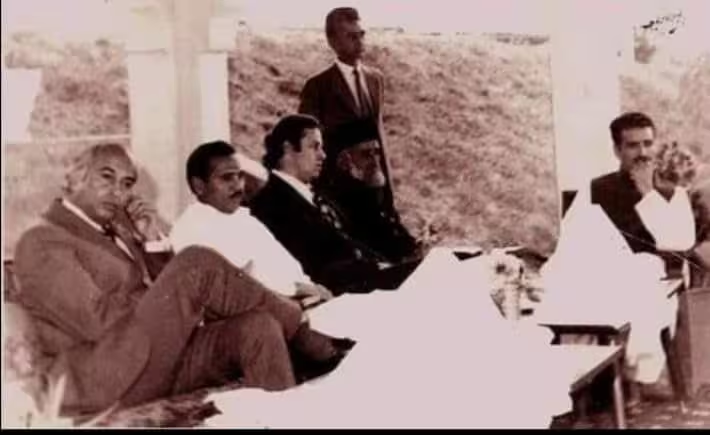
How pressure, political co-option and alleged manipulation in two refugee constituencies were used to keep an independent Kashmir voice out of the Azad Jammu and Kashmir Legislative Assembly
The 1975 Azad Jammu and Kashmir Legislative Assembly election is generally remembered as the beginning of parliamentary government under the constitutional arrangement introduced during Zulfikar Ali Bhutto’s rule. Within the history of the Kashmiri independence movement, however, the election carries another significance: it marked Maqbool Butt’s final attempt to pursue his political programme through the ballot.
Accounts preserved by members and supporters of the Jammu Kashmir Plebiscite Front maintain that Butt contested two refugee constituencies but was defeated through state-backed manipulation favouring Bhutto’s Pakistan Peoples Party. Later testimonies specifically allege that the PPP government pressured him to withdraw, attempted to bring him into the party and interfered with voting at polling stations in the Hazara region.
The surviving public record does not contain the complete nomination papers, candidate-wise vote totals or polling-station returns needed to conduct a modern forensic audit. Nevertheless, official membership records, Kashmiri political histories and testimonies from people associated with the Plebiscite Front provide enough material to reconstruct the dispute, and to explain why Butt’s defeat was widely viewed as political engineering rather than an ordinary electoral loss.
Maqbool Butt’s Earlier Electoral Victory
The 1975 election was not Maqbool Butt’s first experience of electoral politics. After migrating from the Kashmir Valley to Pakistan in 1958, he settled in Peshawar and worked as a journalist. In 1961, he contested a seat representing displaced Kashmiris living in the Peshawar region under the Basic Democracy system introduced in Azad Kashmir during the presidency of K. H. Khurshid.
He won that election.
Butt subsequently campaigned for K. H. Khurshid in the presidential election and for G. M. Lone in the Kashmir State Council election. Both candidates were successful. These victories are important because they challenge the later suggestion that Butt was merely an armed activist without an electoral constituency. Before becoming one of the central figures of the National Liberation Front, he had already demonstrated an ability to organise voters and win a refugee seat.
His political direction changed during the mid-1960s. Butt became convinced that neither India nor Pakistan would voluntarily permit the people of the former princely state to determine their own future. He helped establish the Jammu Kashmir Plebiscite Front in 1965 and later became one of the principal organisers of its underground wing, the National Liberation Front.
After his arrest, trial and imprisonment in connection with the 1971 Ganga hijacking case, Butt was cleared of the main allegation that he had acted as an Indian agent. The experience nevertheless weakened the NLF and exposed its members to imprisonment, torture, financial hardship and political isolation. After his release, Butt attempted to reorganise the independence movement through both political and underground activity.
Why the Plebiscite Front Entered the 1975 Election
The Plebiscite Front’s participation in the 1975 election represented an important strategic experiment. Rather than leaving the constitutional field entirely to parties favouring accession to Pakistan, the Front sought to place the demand for an independent and reunited Jammu and Kashmir before voters.
Maqbool Butt reportedly did not hold an official position in the Front at that time, but he nevertheless entered the contest. Kashmiri political accounts maintain that he stood from two constituencies reserved for refugees from the Kashmir Valley living in Pakistan.
This decision also complicates a popular story associated with Butt’s reported meeting with Bhutto. According to the widely repeated version, Bhutto offered him the office of prime minister of Azad Kashmir, to which Butt supposedly replied that he did not wish to become prime minister of “two and a half districts.” Researchers and former activists have questioned the exact wording of that exchange, partly because Butt subsequently contested two Assembly constituencies. The broader claim that Bhutto or his associates attempted to bring Butt into the PPP, however, appears in several political testimonies.
Identifying the Two Constituencies
The official website of the Azad Jammu and Kashmir Legislative Assembly lists 40 elected members for the 1975–1977 Assembly, followed by two women members on reserved seats.
Its record identifies the final two constituencies as:
- LA-XXXIX, Kashmir Valley-V, won by Sardar Bashir Ahmed Khan
- LA-XL, Kashmir Valley-VI, won by Abdul Hamid Khan
These were refugee constituencies representing Kashmir Valley state subjects settled in Pakistan. Later Kashmiri accounts associate Butt’s campaign with the refugee constituencies covering parts of the Rawalpindi-Murree and Abbottabad-Hazara regions. The references to alleged manipulation at Abbottabad and Shinkiari polling stations also place at least part of his campaign within the Hazara area.
The official Assembly roster records only the successful members. It does not list the defeated candidates, their parties, their vote totals or the individual polling-station results. Therefore, although political accounts repeatedly state that Butt contested two seats, the currently accessible official online record cannot by itself establish his exact vote count or winning margin claimed by his supporters.
This gap in the archive is significant. Without the original nomination papers, electoral rolls, counting statements and polling-station returns, it is impossible to calculate precisely how many votes may have been rejected, transferred, suppressed or incorrectly counted.
Pressure to Withdraw
The first alleged method used against Maqbool Butt occurred before the votes were counted.
In a June 2026 column, Pakistani journalist Hamid Mir wrote that the federal PPP government placed considerable pressure on Butt to withdraw from the 1975 election. According to this account, Butt refused to step aside.
Mir also referred to an interview with Ashraf Qureshi, one of the two men involved in the Ganga hijacking. Qureshi reportedly said that, following Butt’s release in Pakistan, Bhutto offered him the premiership of Azad Kashmir on the condition that he join the PPP. Butt allegedly rejected the proposal, saying that his objective was not to become prime minister but to secure Kashmir’s freedom.
This testimony was recorded many years after the event and should not be treated as equivalent to an official written order from Bhutto. No publicly available document has yet been found containing the offer or instructing Butt to withdraw.
The account is nevertheless politically credible in context. Incorporating Butt into the PPP would have deprived the independence movement of one of its most recognised organisers while allowing Bhutto’s government to present him as part of Pakistan’s constitutional system. His refusal meant that the election became a confrontation between two competing political programmes: the PPP’s Pakistan-centred administration of Azad Kashmir and the Plebiscite Front’s demand for an independent, undivided state.
Alleged Manipulation at Abbottabad and Shinkiari
The most specific allegation concerns polling stations in Abbottabad and Shinkiari.
Hamid Mir’s account states that, after Butt refused to withdraw, he was defeated through rigging at polling stations in these two locations. This suggests that the alleged intervention was not limited to unequal campaigning conditions but extended to the voting or counting process itself.
The available account does not explain the exact technique allegedly employed. It does not specify whether Butt’s polling agents were excluded, ballot boxes were replaced, votes were rejected during counting, turnout figures were altered or administrative officials pressured voters.
For that reason, it would be historically irresponsible to invent a detailed mechanism unsupported by records. What can be stated is that Kashmiri political testimony identifies Abbottabad and Shinkiari as locations where the result was allegedly manipulated after Butt rejected demands to leave the contest.
Locating the original polling records from these stations would therefore be central to any future investigation. Electoral registers, ballot-account forms, counting sheets, objections filed by polling agents and correspondence involving local administrative officials could either substantiate or challenge the allegations.
The Complete Defeat of the Plebiscite Front
The allegations concerning Butt cannot be separated from the wider performance of the Plebiscite Front.
Kashmiriat’s earlier biographical archive records that every Plebiscite Front candidate, including Maqbool Butt, was defeated by PPP candidates. It also notes that Front commentators attributed the result to “massive vote riggings” favouring the PPP.
A complete defeat is not, by itself, proof of fraud. A party may lose all its constituencies because it lacks organisation, resources or sufficient voter support. But the result becomes more politically questionable when considered alongside allegations of withdrawal pressure, attempted co-option, administrative interference and manipulation at identified polling stations.
The election also established a pattern that would define AJK politics for decades. Analysts have repeatedly observed that, since 1975, the political party governing Pakistan has generally enjoyed a decisive advantage in AJK elections and has usually succeeded in forming the government in Muzaffarabad.
This pattern suggests a structural problem larger than one candidate or one election. Refugee constituencies located inside Pakistan are particularly vulnerable to federal influence because their voters, polling stations, officials and administrative arrangements are geographically situated outside AJK itself.
Why Maqbool Butt Was a Political Threat
Maqbool Butt’s importance did not come from the likelihood that he alone could form a government. His threat lay in what an electoral victory would represent.
A seat in the Assembly would have given a leading advocate of an independent Jammu and Kashmir a constitutional platform from which to challenge both Indian and Pakistani claims over the state. Butt could have used legislative proceedings to question Pakistan’s control over AJK, the powers of the Ministry of Kashmir Affairs, the exclusion of Gilgit-Baltistan from AJK’s institutions and the absence of a mechanism through which Kashmiris could exercise their promised right of self-determination.
His election would also have demonstrated that the independence position was not restricted to underground organisations. It had the potential to win support through the ballot among Kashmiris displaced and settled in Pakistan.
For Bhutto’s government, which was attempting to consolidate a new political arrangement in AJK under the 1974 constitutional framework, such a result would have been deeply inconvenient. The PPP wanted its own political authority in Muzaffarabad, while Butt rejected the idea that an AJK government operating under Pakistani supervision could substitute for the liberation and reunification of the entire state.
What the Evidence Establishes
The surviving evidence supports several conclusions.
First, Maqbool Butt had previous electoral experience and had won a refugee seat in 1961. Second, the Plebiscite Front entered the 1975 election and Butt contested as part of that political effort. Third, all Front candidates were officially defeated. Fourth, Plebiscite Front accounts consistently alleged that the PPP benefited from large-scale rigging. Fifth, later testimony alleges that Butt was pressured to withdraw and that manipulation occurred at Abbottabad and Shinkiari polling stations.
The official Assembly record also establishes who occupied the two final Kashmir Valley refugee constituencies after the election: Sardar Bashir Ahmed Khan in LA-XXXIX and Abdul Hamid Khan in LA-XL.
What the digitised record does not yet establish is equally important. No publicly accessible primary document reviewed for this article contains a written instruction from Bhutto ordering officials to falsify the result. Complete candidate lists, constituency-level vote totals and polling-station returns for Butt’s contests have also not been located.
The historically defensible conclusion is therefore not that every detail of the alleged operation has been conclusively proved. It is that multiple Kashmiri accounts describe a coordinated attempt to remove Butt from the electoral field, followed by alleged interference in areas where he was contesting. The official archive, meanwhile, remains too incomplete to independently test those allegations.
From Electoral Defeat to the Final Crossing
The 1975 election appears to have reinforced Butt’s belief that Pakistan’s political system would not permit an independent Kashmiri movement to advance through constitutional means.
The following year, despite the objections of several friends and colleagues, he crossed into Indian-administered Kashmir with Abdul Hamid Butt and Riaz Dar. He was arrested again and ultimately transferred to Tihar Jail, where India executed him on February 11, 1984.
His return to underground activity should not be attributed to the election alone. The weakening of the NLF, the consequences of the Ganga trial, the Simla Agreement and the 1975 Indira-Abdullah Accord all shaped his decision. But his experience in the election was politically instructive: even on the Pakistan-administered side, where officials publicly supported the Kashmiri right to self-determination, an independent Kashmiri organisation could not expect an equal contest against Islamabad’s governing party.
An Unfinished Archival Investigation
The disputed election of 1975 deserves further investigation, not only because Maqbool Butt later became one of the most influential symbols of the Kashmiri independence movement, but because the election helped create a political model that continues to affect AJK.
The essential documents may still survive in government archives, private collections or the records of former Plebiscite Front members. A complete investigation would require:
- Butt’s nomination papers from both constituencies;
- the official candidate lists and party affiliations;
- constituency-wise and polling-station-wise results;
- records from Abbottabad and Shinkiari polling stations;
- complaints submitted by Butt or his polling agents;
- correspondence between the federal government, AJK authorities and local administrations;
- interviews recorded with surviving candidates, election officials and Front activists.
Until those materials are recovered, the public record will remain divided between an official result that records only the winners and a Kashmiri political memory that insists the ballot was manipulated.
What is already clear is that Maqbool Butt entered the 1975 election not to obtain a ceremonial office, but to introduce the demand for an independent Kashmir into an institution designed around Pakistan’s administration of AJK. The pressure to withdraw, the alleged offer of political office and the reported interference at Abbottabad and Shinkiari reveal how threatening even a single independent Kashmiri voice could be to the political order Bhutto was constructing.
Maqbool Butt lost both contests. But the unresolved questions surrounding that defeat have survived the government that declared him defeated, and remain part of the unfinished history of democracy, representation and political control in Pakistan-administered Jammu and Kashmir.
Research and Source Note
This article draws upon the official list of the 1975–1977 AJK Legislative Assembly, political testimony attributed to Ashraf Qureshi, reporting on Butt’s post-1973 activities and later analysis of AJK’s electoral relationship with governments in Islamabad. Where original polling records are unavailable, allegations have been clearly attributed rather than presented as conclusively established facts.
You may also like
-
Mirwaiz Umar Farooq Urges Dialogue and Restraint Over Unrest in Pakistan-administered Jammu Kashmir
-
Who Is Shoukat Nawaz Mir? The Man Behind PaJK’s Largest Protest Movement
-
Haris Qadeer Biography: Kashmiri Journalist, Editor of Mujadala and Jadojehad
-
47 Most Influential Figures in Jammu & Kashmir History (Ancient to Modern)
-
Indian Government Revokes Professor Nitasha Kaul’s Overseas Citizenship