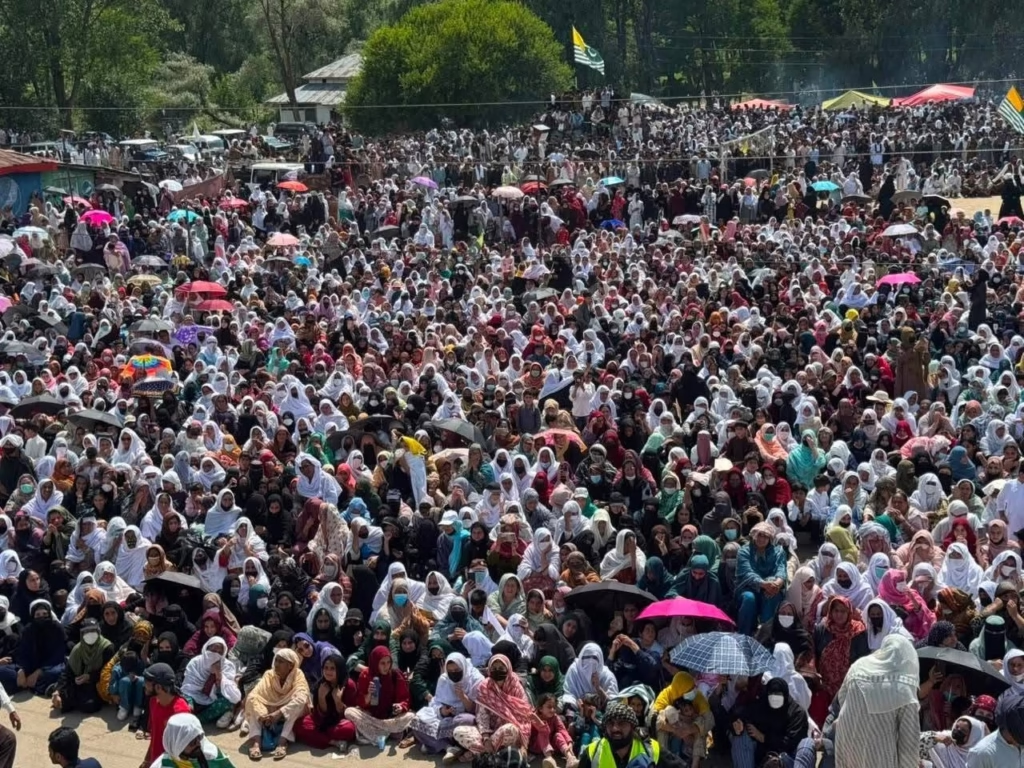
RAWALAKOT: The large presence of women at protests and prolonged sit-ins organised by the Jammu Kashmir Joint Awami Action Committee is emerging as one of the most consequential features of the continuing political movement in Pakistan-administered Jammu and Kashmir.
Women have joined demonstrations in Rawalakot, Neelum Valley, Mirpur Division and smaller towns and villages, often remaining at protest camps alongside children despite road closures, communication restrictions and the threat of renewed clashes.
Several thousand people, including women and children, gathered at Rawalakot’s Eidgah Ground on July 15 ahead of a planned march towards Muzaffarabad, according to local and political sources cited by Dawn. Women and children also staged a peaceful demonstration in Moyel village of Barnala during an earlier phase of the protests.
Their participation has widened a movement initially associated mainly with traders, transporters, lawyers and male civil-society organisers. Women are now visible not simply as relatives accompanying protesters but as participants in rallies, road sit-ins and public gatherings over representation, governance and the implementation of earlier agreements.
The change is politically significant in a region where formal party leadership and elected institutions remain overwhelmingly dominated by men. By entering public protest spaces in large numbers, women are helping transform JKJAAC from a coalition of organised professional groups into a broader household-level movement.
JKJAAC first gained widespread support through demands involving electricity tariffs, subsidised flour and the privileges enjoyed by senior officials. The present movement has expanded to include political representation, state resources, employment, education, refugee policy and opposition to 12 Legislative Assembly seats reserved for refugees residing in Pakistan.
Many of these issues directly affect household finances and access to essential services, helping explain why the protests have drawn women who may not previously have participated in party politics.
Their presence also challenges the assumption that decisions about constitutional arrangements, elections and public resources belong exclusively to established political parties and male-dominated institutions.
The movement’s political influence has grown despite the government banning JKJAAC under anti-terrorism laws, arresting supporters and restricting communications. At least 24 people, including 20 civilians and four police officers, had been killed during nearly two weeks of unrest by June 19, while more than 500 people were detained, according to figures reported by Reuters. Further clashes in July killed nine people, while local estimates placed the wider death toll since June at around 30.
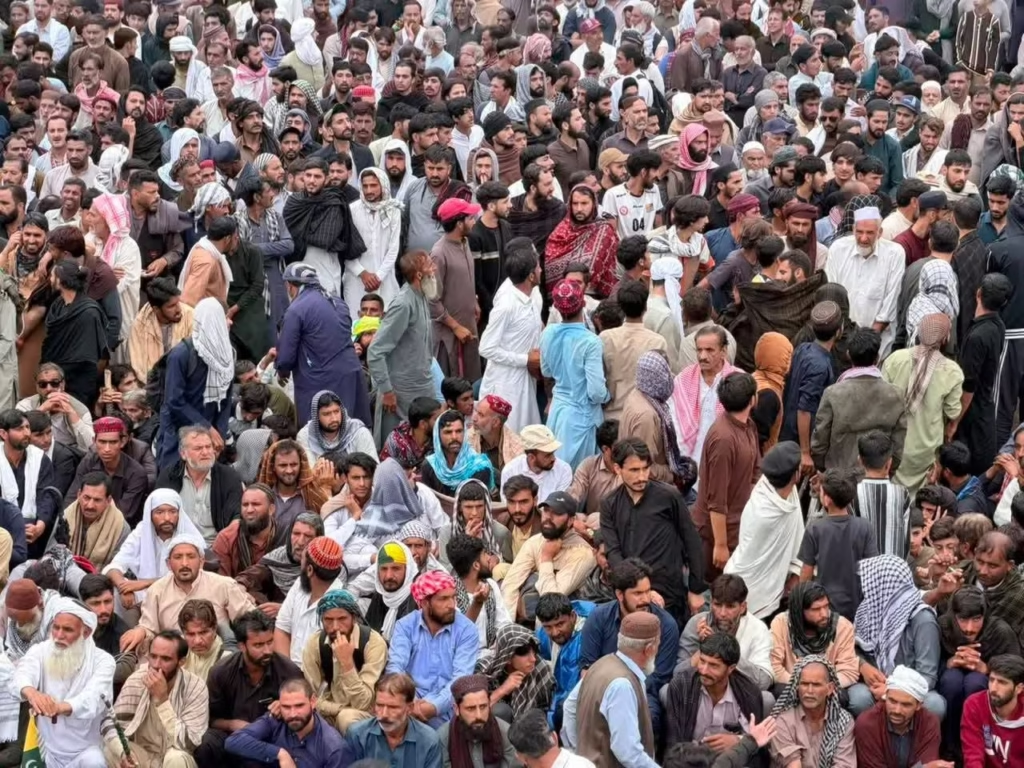
The scale of women’s participation has also become part of the confrontation between JKJAAC and the regional administration.
AJK Home Secretary Chaudhry Guftar Hussain accused the organisation of placing women and children at the front of gatherings and using them as “human shields.” The government has also accused JKJAAC of disrupting public movement, spreading anti-state narratives and exposing students and families to danger.
The claim has not been independently substantiated. Images and reporting from several protest locations show women taking part in organised gatherings, marches and sit-ins, but do not establish that their participation was involuntary.
The government’s description has itself drawn attention to a central political question: whether women at the demonstrations are being treated as independent citizens exercising a right to protest or merely as dependants whose presence must be explained through the decisions of male organisers.
That distinction matters because dismissing women as passive participants risks overlooking the social reach the movement has developed. Women’s participation gives the protests a form of social legitimacy that political parties and traditional pressure groups often struggle to achieve.
A demonstration consisting mainly of party workers can be dismissed as a partisan mobilisation. A sit-in attended by mothers, students, elderly women and families is more difficult to portray as the work of a narrow political faction.
Their presence has also affected how the authorities can respond. Large numbers of women and children at protest sites increase the need for restraint, trained policing and negotiated crowd management. Any use of excessive force against such gatherings carries a higher political and reputational cost.
Amnesty International has already expressed concern about internet shutdowns, mass arbitrary arrests and deadly force during the crackdown on the movement.
The women participating in JKJAAC protests do not necessarily represent a single ideology or constitutional position. Nor is there yet evidence that they have secured an equal role within the movement’s central decision-making bodies. Their public mobilisation nevertheless points towards a changing political reality.
It suggests that political participation in Pakistan-administered Jammu and Kashmir is moving beyond elections, party loyalties and male-dominated negotiating committees. Sit-ins and community mobilisation are increasingly becoming alternative spaces in which residents assert claims over resources, representation and government accountability.
The most lasting consequence may therefore extend beyond the immediate outcome of negotiations.
Women who have spent days at sit-ins, travelled to demonstrations and publicly challenged government policies are unlikely to remain invisible in future debates over elections, local governance and constitutional rights. Their participation is creating expectations of political inclusion that established parties may eventually be forced to address.
For JKJAAC, the challenge will be to ensure that women are not only visible in crowds but also represented in leadership, negotiations and decisions concerning the future direction of the movement.
For the region’s political parties, the message is increasingly clear: women can no longer be approached only as members of political families or voters mobilised during elections. They are becoming an active constituency in their own right, and their participation is beginning to redefine who has the authority to speak in the politics of Jammu and Kashmir.
You may also like
-
Shaukat Nawaz Mir Yet to Be Produced Before Court, Family Denied Access Since Arrest, JKJAAC Says
-
PML-N Leads PaJK Elections Amid Boycott, Rigging Allegations, Violence and Major Political Upsets
-
Muzaffarabad Shuts Down as Clashes and Roadblocks Disrupt Election-Day Movement
-
Civilian Death Toll in PaJK Protests Rises Above 87 as Two More Killed
-
At Least 37 Civilians Killed by Pakistani Security Forces in PaJK in Two Days