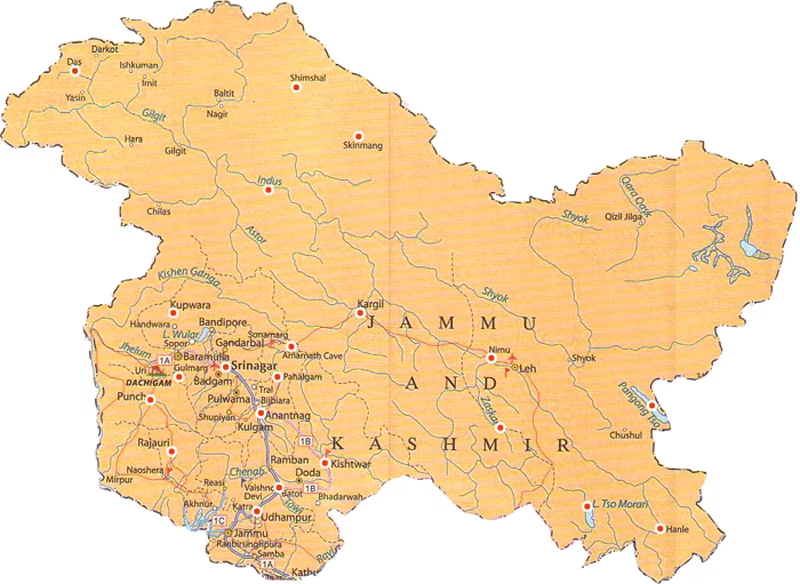
GILGIT: The Gilgit-Baltistan Assembly has unanimously passed a resolution urging Pakistan’s federal government to grant the region interim provincial status, calling for constitutional recognition, representation in Pakistan’s Parliament, and a greater share of national resources.
The resolution requests the federal government to implement the recommendations of the Sartaj Aziz Committee, which proposed granting Gilgit-Baltistan interim provincial status while taking into account Pakistan’s constitutional position on the wider Jammu and Kashmir dispute.
Assembly members said interim provincial status would allow the people of Gilgit-Baltistan to elect representatives to Pakistan’s National Assembly and Senate, ending decades of limited constitutional representation despite the region being administered by Pakistan.
The resolution also calls on the federal government and Pakistan’s four provinces to ensure that, until provincial status is granted, Gilgit-Baltistan is included in the National Finance Commission (NFC) Award and receives what it describes as a fair share of federal financial resources and development funds.
It argues that the region’s residents should enjoy greater political participation and equitable access to national resources while constitutional reforms remain under consideration.
No immediate response from Pakistan’s federal government was available following the passage of the resolution.
The resolution comes amid renewed debate over the constitutional future of territories that formed part of the former princely State of Jammu and Kashmir.
Gilgit-Baltistan has been administered by Pakistan since 1947 but has never been incorporated as one of Pakistan’s constitutional provinces. Instead, it has functioned under separate administrative and legal arrangements, with an elected assembly but without representation in Pakistan’s Parliament.
The constitutional status of Gilgit-Baltistan has remained politically sensitive because the territory forms part of the wider Jammu and Kashmir region, which has been disputed between Pakistan and India since the partition of British India in 1947.
Pakistan has historically maintained that any permanent constitutional arrangement concerning Gilgit-Baltistan should not prejudice the final settlement of the Jammu and Kashmir dispute. The proposal for interim provincial status has therefore been presented by successive Pakistani governments as a temporary administrative arrangement rather than a final constitutional settlement.
India, however, considers the entire former princely State of Jammu and Kashmir, including Gilgit-Baltistan, to be an integral part of its territory and has consistently opposed constitutional changes by Pakistan in the region, arguing that they have no legal validity.
At the same time, political opinion within the wider Jammu and Kashmir region is diverse. While some groups in Gilgit-Baltistan support integration with Pakistan and seek full constitutional rights within the Pakistani federation, other political organisations across Jammu and Kashmir advocate greater autonomy, self-governance, or the right of the people of the former princely state to determine their own political future.
The latest resolution is therefore significant beyond Gilgit-Baltistan itself. It is likely to renew debate over constitutional reform, political representation and the future of territories administered by Pakistan that remain part of the broader and unresolved Jammu and Kashmir dispute.
You may also like
-
Shaukat Nawaz Mir Yet to Be Produced Before Court, Family Denied Access Since Arrest, JKJAAC Says
-
PML-N Leads PaJK Elections Amid Boycott, Rigging Allegations, Violence and Major Political Upsets
-
Muzaffarabad Shuts Down as Clashes and Roadblocks Disrupt Election-Day Movement
-
Civilian Death Toll in PaJK Protests Rises Above 87 as Two More Killed
-
At Least 37 Civilians Killed by Pakistani Security Forces in PaJK in Two Days