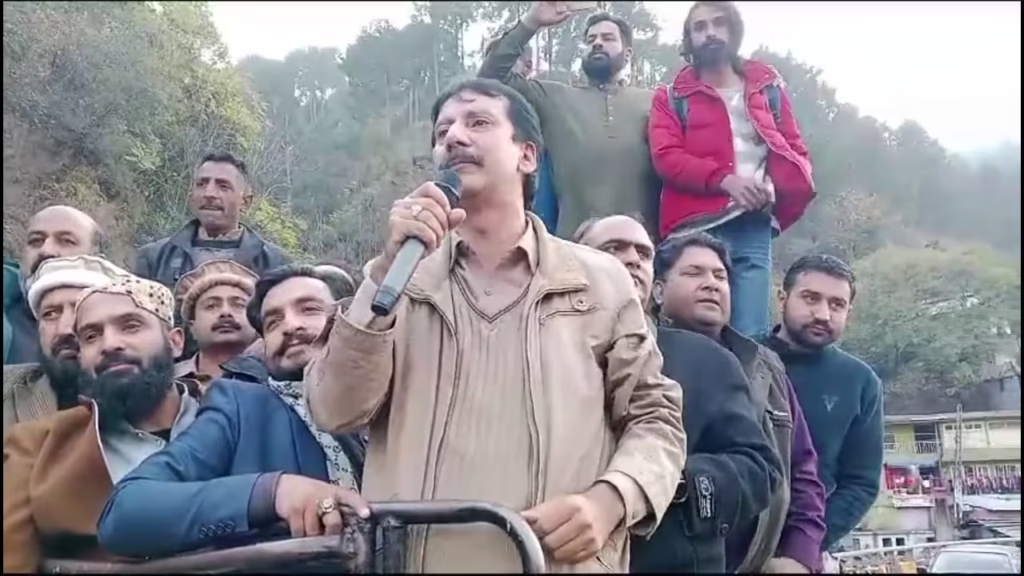
MUZAFFARABAD: The Jammu Kashmir Joint Awami Action Committee (JAAC), which began as a broad civil society platform around public anger over electricity bills, wheat flour prices and official privileges, has over time developed into one of the most consequential protest movements in Pakistan-administered Jammu Kashmir, pushing the authorities from economic concessions towards a larger debate over governance, political representation and constitutional authority.
The movement’s present phase centres on a dispute over 12 legislative assembly seats reserved for Kashmiri refugees living elsewhere in Pakistan, but its roots go back to earlier mass protests over the cost of living, power tariffs and the demand that local resources should benefit the people of Jammu Kashmir first.
Early Demands: Electricity, Flour and Public Relief
JAAC’s first major mobilisation drew strength from everyday economic grievances. Protesters demanded subsidised wheat flour, lower electricity tariffs, and relief from rising prices. A central argument of the movement was that consumers in Pakistan-administered Jammu Kashmir should not pay high electricity rates while the region’s rivers and hydropower resources contribute to wider power generation.
In May 2024, after several days of protests and clashes, JAAC called off a protest march following the approval of a major financial package by Pakistan’s federal government. Reuters reported at the time that Prime Minister Shehbaz Sharif approved a grant of Rs24 billion to help meet most of the protesters’ demands, including subsidies on flour and electricity. The subsidised price of 40 kilograms of flour was reduced from Rs3,100 to Rs2,000, while electricity prices were also reduced.
The same wave of protests resulted in deaths and injuries. Reuters reported that four people were killed and more than 100 injured during that phase of unrest, including protesters and a police official. JAAC leader Shaukat Nawaz Mir later announced that the march would be called off after the government accepted the major economic demands.
From Economic Relief to Structural Demands
Although the 2024 concessions temporarily eased tensions, the movement did not end. Over time, JAAC’s demands expanded beyond flour and electricity to include wider questions of governance, accountability and representation.
The movement’s charter came to include demands such as:
- reduction or abolition of official privileges enjoyed by ministers, lawmakers, judges and senior bureaucrats;
- reform of governance and administrative structures;
- implementation of local government powers;
- relief in taxes and public charges;
- better infrastructure, roads, hospitals and water schemes;
- recognition of local resource rights, including hydropower-related questions;
- and abolition or restructuring of the 12 assembly seats reserved for refugees from Indian-administered Jammu Kashmir who reside in Pakistan.
This shift turned JAAC from a price-relief movement into a wider public rights platform. The dispute also began touching directly on the constitutional relationship between Pakistan-administered Jammu Kashmir and Pakistan’s federal institutions.
The 38-Point Charter and Agreement With Authorities
In 2025, negotiations between JAAC, the Pakistan-administered Jammu Kashmir government and the federal government centred on a 38-point charter of demands. Dawn reported that talks had broken down at one stage after JAAC pressed for the abolition of elite privileges and the 12 reserved refugee seats, but later the federal government signed an agreement with the committee to end the tense situation.
The agreement covered several administrative, infrastructure and policy commitments. According to Dawn, the Centre pledged Rs10 billion for improvement of the region’s electricity system and agreed to feasibility studies for tunnels on the Neelum Valley Road. The agreement also included commitments regarding Mangla Dam-related land issues, hydel project decisions, water supply schemes, transport policy review and local government reforms.
The agreement also proposed a high-powered committee of legal and constitutional experts to deliberate on the issue of assembly members elected from outside Pakistan-administered Jammu Kashmir constituencies. It further provided for a monitoring and implementation committee including representatives from the federal government, the local government and JAAC, tasked with reviewing implementation timelines and resolving disputes.
Another important part of the agreement was the review of official perks and privileges. Dawn reported that the monitoring committee would review existing privileges and fringe benefits authorised to the judiciary, government officials and ministers in order to rationalise them.
What Authorities Say Has Been Fulfilled
Government officials maintain that most of JAAC’s demands have already been accepted or addressed. Associated Press reported that Pakistan-administered Jammu Kashmir Prime Minister Faisal Mumtaz Rathore said the authorities had accepted 36 of JAAC’s 38 demands after negotiations involving JAAC representatives, regional officials and Pakistan’s federal government.
In another account, Adviser to the Prime Minister Rana Sanaullah was quoted as saying the government had accepted 37 of 38 demands, with the refugee seats remaining the only unresolved issue. The Express Tribune also reported that the government and JAAC had earlier reached an agreement covering 12 core and 13 additional points.
The fulfilled or partially fulfilled demands, according to government and media reports, include:
- subsidised wheat flour;
- reduced electricity tariffs;
- financial support for the electricity system;
- infrastructure commitments, including road and tunnel feasibility studies;
- some health and water supply schemes;
- transport policy review;
- tax-related relief proposals;
- creation of committees to monitor implementation;
- and a formal mechanism to examine refugee-seat and privileges-related issues.
However, JAAC and local supporters have repeatedly argued that acceptance on paper is not the same as full implementation on the ground. This gap between official claims and public perception has remained a major source of distrust.
Remaining Demands and the Refugee Seats Dispute
The most sensitive unresolved demand is the abolition or restructuring of the 12 reserved seats in the Legislative Assembly for Kashmiri refugees living in Pakistan. Protesters argue that the arrangement gives political influence to people who do not reside in Pakistan-administered Jammu Kashmir and affects the formation of local governments.
The issue became more contentious ahead of the July 2026 elections. Reuters reported that the recent unrest began ahead of a June 9 strike called by JAAC against the reservation of these 12 seats in the elections for the region’s 45-seat assembly.
The authorities maintain that the seats are constitutionally protected and cannot be abolished through executive order. In June 2026, the Supreme Court of Pakistan-administered Jammu Kashmir ruled that the 12 refugee seats are constitutionally protected and can only be changed through a constitutional amendment. The court also ruled that elections must be held within the prescribed constitutional period.
This ruling strengthened the government’s position but deepened the confrontation with JAAC, which continued to insist that the issue of representation lies at the heart of democratic legitimacy in the region.
The second major unresolved area concerns elite privileges. While the authorities say a mechanism exists to review and rationalise official perks, JAAC supporters argue that meaningful reduction of privileges has not been fully carried out.
Sit-ins, Strikes and Long Marches
JAAC has repeatedly used strikes, sit-ins and long marches as pressure tactics. Its earlier mobilisations included shutter-down strikes, road blockades and marches towards Muzaffarabad. In June 2026, the movement again called strikes and sit-ins across several districts, including Rawalakot, Muzaffarabad, Mirpur and other towns.
Associated Press reported that shops and public transport shut down across Pakistan-administered Jammu Kashmir after JAAC’s strike call in June, while authorities deployed additional security forces and suspended internet services in major cities to prevent people from joining the march.
Reuters reported that by June 19, thousands of JAAC supporters were camped on the outskirts of Rawalakot, while the government responded with road closures, internet restrictions and limits on media access. The same report said the shutdown had badly affected daily life, including workers, transporters, markets, ATMs and fuel availability.
The confrontation escalated again in July. Arab News reported that JAAC warned it would march towards Muzaffarabad on July 15 if its demands were not met. In a statement, JAAC said: “After July 14, our demands will not be limited to this Charter of Demand. We will come out with a new announcement.”
That statement marked a significant shift. It suggested that the movement’s demands could expand beyond the existing 38-point charter if the authorities failed to reach a settlement.
Ban, Arrests and Security Crackdown
The regional government banned JAAC in June under anti-terrorism laws, citing public order and security concerns. AP reported that the ban was followed by arrests of dozens of supporters, while authorities said they remained willing to discuss the two remaining demands.
Human rights organisations have criticised the response. Amnesty International said the crackdown in Pakistan-administered Jammu Kashmir included internet shutdowns, mass arbitrary arrests and deadly use of force, describing the terrorism designation of the protest movement as a dangerous escalation.
Reuters reported on June 19 that at least 24 people had been killed in nearly two weeks of protests, including at least 20 civilians and four police officers, while police said 515 people had been detained and 97 officers wounded.
On July 14, Reuters reported that nine more people were killed in clashes between security forces and supporters of the banned protest group. According to Poonch Divisional Commissioner Waheed Khan, six protesters and one police official were killed in Tararkhal, while another protester and a security official were killed in Rawalakot. Reuters cited local estimates saying around 30 people had been killed in the unrest since June.
Local activist and JAAC-linked tallies have placed the total death toll higher, saying more than 41 people have been killed since the beginning of the current phase of sit-ins and clashes. No comprehensive official casualty list has been released, making independent verification of the full toll difficult.
Authorities’ Position
The government’s position is that most demands have already been addressed and that the remaining issues require constitutional or legislative action. Officials argue that road blockades, shutdowns and disruption of public life cannot be allowed to continue indefinitely.
Authorities also say the refugee-seat issue cannot be decided by the executive branch alone. The Supreme Court ruling has reinforced that position by declaring that any change to the reserved seats must come through a constitutional amendment rather than administrative action.
The government has also accused some JAAC supporters of violence. AP reported official allegations that armed supporters of the group opened fire on officers during clashes, while JAAC-linked voices and local residents have accused security forces of using excessive force against protesters.
Protesters’ Position
JAAC and its supporters maintain that the movement represents public grievances over economic hardship, resource rights, governance failures and political under-representation. They argue that the people of Pakistan-administered Jammu Kashmir should have full control over local decision-making and that non-resident refugee seats distort democratic representation.
For many supporters, the movement is no longer only about electricity or flour. It has become a wider demand for dignity, accountability, local authority and recognition of the political rights of the people living in the territory.
The July statement that demands would not remain limited to the existing charter after July 14 indicates that the movement may now add new demands related to deaths, arrests, compensation, release of detainees, accountability for the use of force and a broader review of the region’s constitutional status.
What Remains Unresolved
Despite several agreements and official claims of implementation, the core unresolved issues remain:
- Reserved refugee seats: JAAC wants abolition or restructuring of the 12 seats reserved for refugees living in Pakistan; the government says this requires constitutional amendment.
- Elite privileges: The government agreed to review perks and privileges, but protesters argue that meaningful reduction has not been fully implemented.
- Implementation gap: Several agreement points require timelines, funding, monitoring and execution, and protesters say written commitments have not translated into visible change.
- Accountability for deaths and injuries: After repeated clashes, rights groups and local activists have called for independent investigations into the use of force.
- Detainees and legal cases: Hundreds have reportedly been detained during the current phase, and protest supporters are demanding legal production, release or due process.
- Political and constitutional status: The movement has widened debate over representation, resource control, governance and the limits of local authority under the existing constitutional arrangement.
A Movement at a Turning Point
The JAAC movement has moved through three broad phases: first, a campaign for economic relief; second, a negotiated reform agenda; and third, a confrontation over political representation and constitutional power.
Authorities say they have accepted most demands and cannot unilaterally alter constitutionally protected seats. Protesters say the unresolved demands go to the heart of democratic rights and local control.
The result is a standoff that has turned Pakistan-administered Jammu Kashmir into the centre of a widening political crisis. With deaths, arrests, road closures and growing public anger, the dispute is no longer only about a charter of demands. It is now about the relationship between the governed and those who govern.
For the people of Jammu Kashmir, the central question remains whether political issues will be resolved through dialogue, accountability and public consent — or through confrontation, bans and force.
You may also like
-
Shaukat Nawaz Mir Yet to Be Produced Before Court, Family Denied Access Since Arrest, JKJAAC Says
-
PML-N Leads PaJK Elections Amid Boycott, Rigging Allegations, Violence and Major Political Upsets
-
Muzaffarabad Shuts Down as Clashes and Roadblocks Disrupt Election-Day Movement
-
Civilian Death Toll in PaJK Protests Rises Above 87 as Two More Killed
-
At Least 37 Civilians Killed by Pakistani Security Forces in PaJK in Two Days