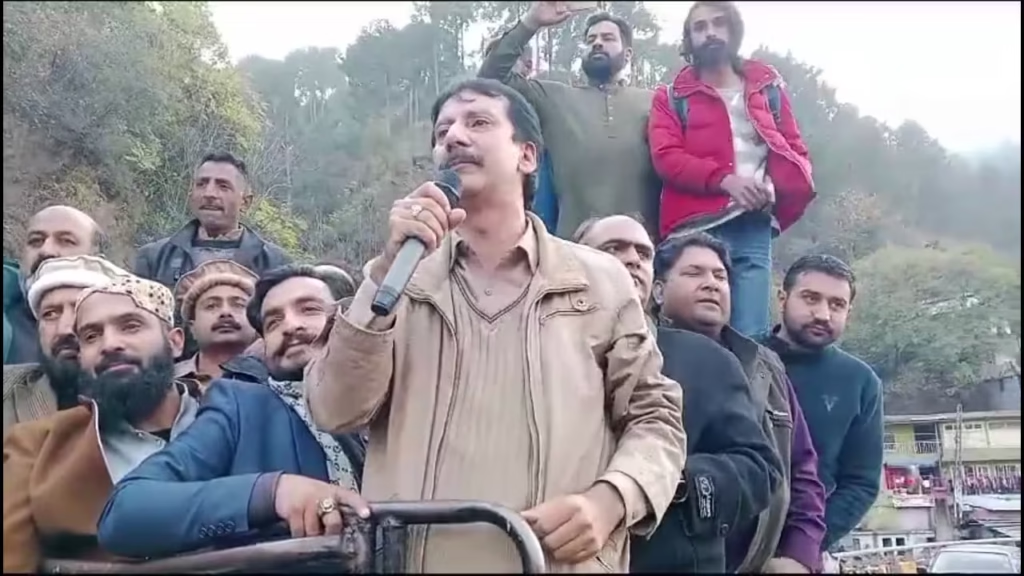
At least 54 people, including protesters, civilians and members of the police and security services, have reportedly lost their lives during three major cycles of unrest connected with the Jammu Kashmir Joint Awami Action Committee over the past three years. Four people were killed during the May 2024 protests, at least nine died during the October 2025 confrontation, and local reports indicate that around 41 more have been killed since the present crisis began in June 2026.
The most alarming figure is the toll from the past 39 days alone. Approximately 41 people have reportedly died during the latest period of protests, blockades, security operations and violent confrontations. Behind every statistic is a family that has lost a son, father, brother or breadwinner. These deaths have transformed what began as a political and constitutional dispute into one of the gravest civil-rights crises PaJK has experienced in recent decades.
The figures must be treated carefully because restrictions on communications and media access, together with differing accounts from officials, residents and protest organisers, have made independent verification difficult. Nevertheless, even the most conservative reports establish that the human cost has already become intolerably high. By June 19, Reuters had reported at least 24 deaths, 20 civilians and four police officers, during the first two weeks of unrest. Further clashes on July 14 killed nine more people, while local sources placed the cumulative toll from the current crisis at around 41.
For the Jammu Kashmir Joint Awami Action Committee, therefore, the continuing sit-in is no longer merely a campaign for the acceptance of its demands. It has become a struggle for political survival, and, for many families, a struggle shaped by blood already shed.
Calls to end, cancel or postpone the sit-in may sound reasonable to those watching from a distance. Ordinary people are suffering. Roads have been blocked, businesses have been disrupted, essential supplies have been affected, and families dependent upon daily wages are under severe pressure. These consequences cannot be dismissed.
But the Committee’s leadership faces a brutal calculation: ending the movement without a binding political settlement may not restore normality. It may instead mean that dozens of people died without securing either justice or lasting political protection. It could also leave the organisation, its leaders and its supporters exposed to a state crackdown after they have surrendered their only remaining source of collective protection, the continued presence and solidarity of people on the streets.
After at least 54 reported deaths across three years, including around 41 in just the latest 39-day period, the Committee cannot present an unconditional withdrawal as a harmless postponement. Its supporters would see such a decision as abandoning the sacrifices already made, while the state would retain the power to arrest organisers, prosecute participants and keep the organisation proscribed.
This is why the present moment has become a do-or-die political condition for the Committee. That phrase must never be understood as a call for further violence or loss of life. It means that the movement believes it must now secure enforceable guarantees, legal protection and a dignified political settlement, or risk losing its leadership, its organisation and the possibility of comparable peaceful resistance for a generation.
Postponement Could Become Surrender
In an ordinary political dispute, a movement can temporarily suspend its campaign, enter negotiations and return to protest if dialogue fails. That option becomes far less credible once the movement itself has been outlawed.
Should the Committee disperse its supporters without obtaining written guarantees, the state would retain the power to pursue its leadership individually. Organisers, activists, transporters, volunteers and even ordinary participants could become vulnerable to arrest once the protection provided by mass mobilisation disappears.
There is no certainty that every participant would be arrested, nor can anyone responsibly predict the sentence in an individual case. Courts must determine guilt, and every accused person is entitled to due process. Nevertheless, prosecution under anti-terrorism, sedition or public-order provisions creates the risk of prolonged detention, lengthy trials and severe imprisonment.
Amnesty International has described the terrorism designation, mass arrests and reported use of force as a dangerous escalation against a protest movement. Reuters reported in June that more than 500 people had been detained during the unrest, while restrictions on roads, communications and media access had intensified.
For the Committee, therefore, the central question is not simply whether it should pause the sit-in. It is whether its members would still be free, organised and legally capable of resuming their movement after such a pause.
The leadership has good reason to fear that the answer may be no.
A Ban Is Easier to Impose Than to Reverse
The government’s decision to proscribe the Committee has placed a permanent shadow over every negotiation.
Even if demonstrations are suspended, the organisation will not automatically regain legal recognition. A ban imposed under anti-terrorism legislation ordinarily requires a formal legal or administrative process to reverse. Verbal assurances, private messages and vague promises of later reconsideration are therefore inadequate.
The government has publicly defended the ban by alleging threats to security and public order. State media has repeatedly described the Committee as proscribed or banned, while officials have accused it of violence and disruption. The Committee and human-rights advocates dispute the state’s characterisation of the movement and argue that legitimate political grievances are being treated as terrorism.
Once authorities have constructed such a narrative, they are unlikely to abandon it merely because protesters have gone home.
A suspension without the withdrawal of the proscription order would therefore amount to unilateral disarmament. The state would keep its cases, its detention powers and its official designation of the organisation, while the Committee would lose the crowds that give it political leverage.
That is not a compromise. It is an imbalance of power.
The Leadership Is Trapped Between Two Dangers
The Committee now faces dangers from both directions.
Continuing an indefinite confrontation carries an intolerable human cost. The unrest has already produced deaths among civilians and security personnel, many injuries, economic paralysis and hardship for people who may have no direct involvement in the dispute. Reuters reported that at least 24 people had died during two weeks of unrest by June 19; further deadly clashes were reported on July 14.
No political objective can justify treating further loss of life casually. Protest organisers have a moral responsibility to maintain non-violent discipline, protect civilians, permit humanitarian access and prevent armed individuals from exploiting public gatherings. The authorities have an equal and greater responsibility to exercise restraint, avoid indiscriminate arrests and ensure that force is used only when strictly necessary and proportionate.
Yet abandoning the movement without safeguards carries a different danger: the systematic dismantling of the Committee after mobilisation ends.
Its leadership may reasonably believe that once supporters disperse, arrests will intensify, prosecutions will continue, and the organisation’s networks will be broken district by district. Whether or not every feared arrest occurs, the existing ban and the scale of reported detentions make that concern impossible to dismiss as mere paranoia.
This is why the situation has become, politically speaking, a do-or-die moment for the Committee. “Do or die” must not mean seeking violence or sacrificing lives. It means that the organisation believes its continued existence depends upon securing enforceable guarantees before ending collective action.
A Defeat Could Silence Public Mobilisation for a Generation
Mass movements do not arise simply because leaders announce them. They require years of accumulated grievances, local organisation, public confidence and a belief that collective action can produce results.
The Joint Awami Action Committee developed political weight through campaigns concerning electricity tariffs, flour prices, elite privileges, governance and political representation. In 2024, sustained mobilisation was followed by substantial government concessions on flour and electricity pricing. That experience strengthened public confidence in organised protest as an instrument of negotiation.
If the present movement ends with mass arrests, terrorism prosecutions and the permanent banning of its central organisation, the consequences will extend beyond the fate of its current leaders.
Citizens will absorb a stark lesson: participation carries enormous personal danger, while negotiated assurances offer little protection. Shopkeepers will hesitate before closing businesses. Transporters will avoid supporting strikes. Families will discourage young people from attending demonstrations. Local organisers will fear surveillance, prosecution and financial ruin.
Under such conditions, another movement of comparable scale may not emerge for decades.
This would not mean that public grievances had disappeared. It would mean that fear had overwhelmed the capacity to express them collectively. Suppressed grievances do not create stability; they create silence on the surface and resentment underneath.
The Wider Civil-Rights Movement Is Watching
The consequences of this confrontation will not be confined to the Joint Awami Action Committee or to Pakistan-administered Jammu and Kashmir. Civil-rights groups, human-rights defenders, trade unions, student organisations and peaceful political movements elsewhere are watching closely.
For many observers, the rise of the Committee represents a significant achievement by the people of PaJK. It demonstrated that ordinary citizens could organise across districts, unite around shared economic and political grievances, challenge entrenched privilege and compel those in power to listen. Whatever one’s view of the Committee’s methods or demands, its ability to build a broad grassroots movement has already changed the political consciousness of the region.
That achievement now stands at risk.
Should the movement end without meaningful guarantees, and should its leaders, workers and participants subsequently face arrests, prolonged imprisonment or the permanent destruction of their organisation, the damage will reach far beyond the present dispute. Other civil-rights and human-rights movements will conclude that peaceful organisation offers no protection, that public mobilisation leads only to criminalisation, and that even a movement commanding widespread popular support can be dismantled once its supporters leave the streets.
Such an outcome could destroy hope in democratic resistance for years, perhaps decades. People confronting injustice elsewhere would become less willing to organise, speak openly or participate in collective action. Families would discourage political involvement, local leaders would avoid responsibility, and communities would lose faith in peaceful struggle as a means of securing rights.
The defeat of the Committee would therefore not be seen merely as the end of one sit-in. It could be interpreted as the closing of political space for an entire generation. Conversely, a negotiated and dignified settlement, one that protects participants, restores lawful civic activity and addresses legitimate grievances, would send an equally powerful message: that disciplined, peaceful and organised public resistance can still achieve meaningful change.
This is why the outcome matters to every civil-rights and human-rights movement watching from beyond PaJK. What happens to the Committee will either preserve public faith in peaceful collective struggle or deepen the belief that resistance is futile and that silence is the only safe option.
The Sit-In Must Have a Political Exit
Recognising why the Committee cannot simply withdraw does not mean endorsing an endless shutdown.
A responsible movement must offer the public a political strategy, not only endurance. The sit-in should be linked to clear, achievable conditions for de-escalation. These should include a written agreement, independently witnessed negotiations, the release or lawful review of detainees, guarantees against retaliatory arrests, transparent investigation of all deaths, restoration of communications, and a formal legal pathway for reviewing the Committee’s proscription.
Humanitarian corridors must remain open. Hospitals, ambulances, medicines, food supplies and emergency travel must never become bargaining chips. Protest marshals should enforce an explicit ban on weapons, attacks on public employees and destruction of property. Every death weakens the moral foundations of the movement and gives the state further grounds for repression.
The government, for its part, must recognise that outlawing a broad civil movement and prosecuting political dissent through terrorism laws cannot produce a durable settlement. Negotiation conducted while one side faces arrest at any moment is not meaningful dialogue.
The objective should not be the humiliation of the state or the unconditional victory of the Committee. It should be a framework in which citizens can raise political demands without being treated as terrorists and public institutions can function without fear of violence.
They Cannot Leave Empty-Handed
The harsh reality is that the Committee cannot safely end or postpone its mobilisation merely in exchange for another promise of talks.
It needs enforceable protections.
Without the lifting or judicial review of the ban, guarantees against reprisals, due process for detainees and an agreed mechanism for resolving the underlying political dispute, dispersal could expose the entire movement to fragmentation and prosecution.
The government may have the physical power to clear roads and arrest leaders. But coercive control should not be mistaken for political resolution. A movement can be driven from public spaces while the grievances that created it remain alive.
The Committee must also understand that public support is not inexhaustible. It will lose moral authority if ordinary citizens are denied food, medicine, work and safe passage. Its strongest position lies in disciplined, peaceful pressure combined with a credible negotiating programme.
This is no longer simply a dispute over whether a sit-in should continue for another day or another week. It is a struggle over whether organised civil resistance will retain any lawful political space in Azad Jammu and Kashmir.
The Committee cannot afford to go home empty-handed. The state cannot afford to believe that mass arrests will settle the matter. Both sides must now create an exit based on guarantees, accountability and dialogue, before more families pay the price for a political conflict that should never have been allowed to become so deadly.

Jawad Ahmed Paras hails from Pakistan-administered Jammu Kashmir and is a talented filmmaker and journalist. He obtained his filmmaking degree from Beaconhouse National University in Lahore. With a rich background in the field, Jawad serves as the esteemed chief editor of Kashmiriat and Kashmiriat Urdu, where he has dedicated the past six years of his career. His passion lies in exploring the captivating aspects of Kashmir’s history, culture, music, poetry, and art.
You may also like
-
How JAAC’s Protest Movement Expanded Across Pakistan-administered Jammu Kashmir
-
Why 12 Non-Resident Constituencies Have Become Central to AJK’s Political Crisis
-
Terrorism as a Colonial Term
-
5 January Resolution: A Conditional trap for Kashmiris
-
Navigating Constitutional Norms and Governance in AJK’s Asset Transfer Controversy