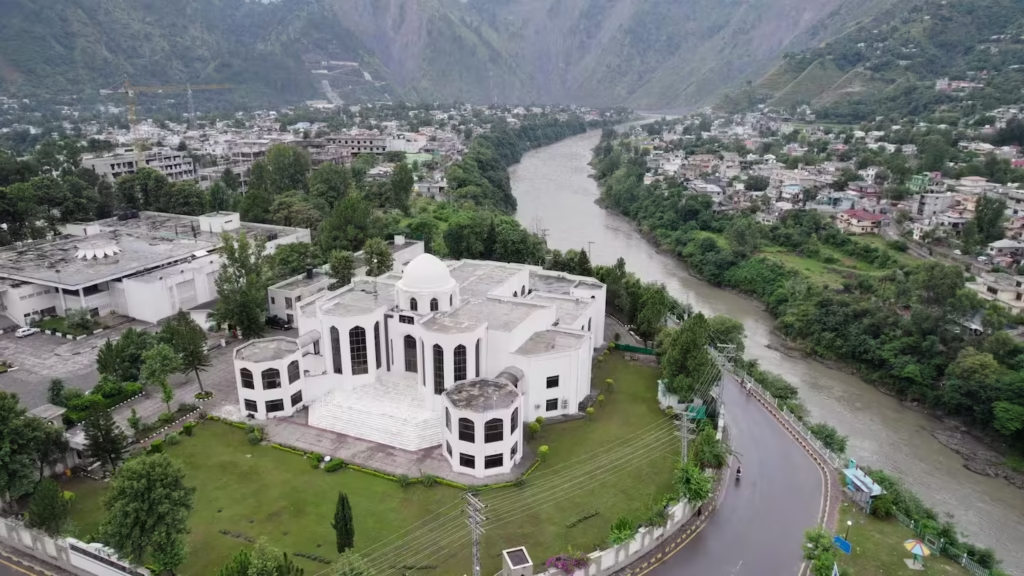
Muzaffarabad is not only the administrative capital of Pakistan-administered Jammu Kashmir. It is one of the most important historical gateways of the wider Jammu Kashmir region: a city shaped by rivers, mountain routes, forts, trade, spiritual traditions, wars, earthquakes, and the unresolved political future of the Kashmiri people.
Located at the meeting point of the Jhelum and Neelum rivers, Muzaffarabad has long connected Kashmir Valley, Hazara, Poonch, Punjab, and the high mountain corridors leading further north. Its geography has made it a place of beauty, but also a place of repeated strategic interest. Empires, local rulers, traders, soldiers, refugees, students, political activists, and ordinary families have all left their marks on the city.
To understand Muzaffarabad is to understand one of the central truths of Jammu Kashmir: the region’s history cannot be reduced to the official narrative of any state. It is older than Pakistan and India, older than the Line of Control, older than the modern dispute, and far deeper than the political maps that divide it today.
Geography: The City of Two Rivers
Muzaffarabad sits at Domel, the confluence of the Neelum River, historically known as Kishanganga, and the Jhelum River, historically associated with the ancient name Vitasta. The city is surrounded by mountains and shaped like a valley basin, with settlements rising along slopes, ridges, and riverbanks. A 2022 archaeological study published in Ancient Punjab describes Muzaffarabad as a city situated on the riverbanks of Jhelum and Neelum and surrounded by mountains, while also identifying it as a historic corridor between Kashmir and neighbouring regions.
This geography explains much of the city’s history. Muzaffarabad was never merely a town; it was a passage. Travellers moved through it on the way to Kashmir Valley. Armies looked at it as a defensive position. Traders saw it as a route. Sufi saints and religious communities established shrines, mosques, temples, gurdwaras, gardens, sarais, and bazaars along its river paths. The same archaeological study lists Red Fort, Sarai Alamgiri, Jalalabad Garden, Buddhist caves, mandirs, a shamshan ghat, Domel Bridge, Shaukat Lines Gurdwara, and old bazaars among the city’s important historical sites.
The city’s location also made it vulnerable. Floods, landslides, earthquakes, and conflict have repeatedly damaged its built heritage. In many cases, only fragments of older Muzaffarabad survive.
Before the Modern City: Ancient and Early Medieval Context
The modern city of Muzaffarabad was founded in the seventeenth century, but the wider region around it belongs to the older civilisational world of Jammu Kashmir. Ancient Kashmir was an important centre of Hindu, Buddhist, and later Islamic learning and culture. Kashmir’s historical traditions refer to its ancient rulers, sacred geography, and intellectual life, including the role of Buddhism under early imperial influences and the later development of Kashmir Shaivism. The official Jammu and Kashmir Tourism history page notes Kashmir’s association with Ashoka, Buddhism, the Kushans, Kanishka, and later Hindu dynasties such as the Karkotas and Utpalas.
Although ancient Muzaffarabad is less documented than Srinagar, Baramulla, or Sharda, the region’s location suggests it formed part of the broader cultural and trade network of western Kashmir. The archaeological remains identified around the city show a multi-religious past: Buddhist, Hindu, Sikh, and Muslim structures existed across the area at different times.
For Kashmiri history, this matters. Muzaffarabad’s story is not only a story of rulers. It is also a story of routes, languages, faiths, migrations, and shared spaces. The city’s cultural identity grew from its position between valleys and communities.
Islam, Sufi Influence, and Local Society
Islam spread across Kashmir gradually from the fourteenth century onward, through political change, Sufi influence, trade, and social transformation. The process was not uniform across all parts of Jammu Kashmir. In many mountain regions, older practices, local customs, and new religious identities coexisted for generations.
Muzaffarabad’s Muslim identity grew through both political and spiritual channels. Shrines and mosques became central to social life. The 2022 archaeological study records several Muslim religious sites in Muzaffarabad and notes the importance of Sufi shrines in local memory, including shrines associated with Shah Sultan and Shah Inayat. It also refers to the Sultani Masjid as a historic memorial connected with Sultan Muzaffar Khan.
This spiritual history is important because Muzaffarabad was not built only by armies and rulers. It was also shaped by saints, traders, craftspeople, farmers, and river communities. Like other parts of Jammu Kashmir, its social life developed through a mixture of local ethnic groups, religious traditions, and mountain economies.
The Bomba Chiefs and the Founding of Muzaffarabad
The modern city of Muzaffarabad is generally associated with Sultan Muzaffar Khan, a local ruler from the Bomba tribe. Historical accounts commonly state that the city was founded in the seventeenth century and named after him. The Walled City of Lahore Authority’s conservation note on Red Fort states that Sultan Muzaffar Khan of the Bomba dynasty, described as the founder of Muzaffarabad, repaired and completed the fort in 1646 and used it as a military base.
There are slight variations in local histories about dates and details. Some accounts connect the founding directly to 1646, while some local references associate Sultan Muzaffar Khan’s memory with earlier settlement phases. Because much of early Muzaffarabad’s history relies on regional chronicles, oral traditions, and later gazetteers, exact dates should be treated carefully. What is clear, however, is that the city’s name preserves the memory of Sultan Muzaffar Khan and the local power structure that existed before stronger imperial consolidation.
Muzaffarabad’s founding at the confluence of two rivers was not accidental. The site offered water, movement, defence, and visibility. It was close enough to Kashmir Valley routes to matter politically, yet protected enough by mountains and rivers to serve as a local stronghold.
Red Fort: The City’s Great Historical Landmark
No monument represents old Muzaffarabad more clearly than the Red Fort, also known as Rutta Qila, Surkh Qila, or Muzaffarabad Fort.
The fort stands near the Neelum River and was positioned with defence in mind. According to the Walled City of Lahore Authority, construction of the fort began in 1559 during the Chak period, when Kashmir’s rulers feared Mughal expansion. The site was chosen because the Neelum River curved around it in a U-shape, giving it natural protection on several sides.
The fort later lost some of its strategic importance after the Mughal annexation of Kashmir in the late sixteenth century. It returned to prominence when Sultan Muzaffar Khan repaired and completed it in 1646. During Dogra rule in the nineteenth century, Maharaja Gulab Singh and later Maharaja Ranbir Singh repaired and extended the fort again. It remained in military use until 1926, after which it was abandoned when a new cantonment was built.
The 2022 archaeological study also identifies the fort as a key site in Muzaffarabad’s heritage, noting that it was listed by the AJK Archaeology Department and that local names such as Red Fort, Ratta Qila, and Surkh Qila are connected to its brick-red colour.
The fort is more than a tourist site. It is a physical archive of Muzaffarabad’s layered history: Chak anxiety over Mughal expansion, local Bomba rule, Dogra militarisation, post-1947 abandonment, and modern conservation efforts. It also reflects a wider problem in Jammu Kashmir: historical structures are often damaged by conflict, disasters, neglect, or state indifference.
Mughal Influence and the Imperial Road to Kashmir
Kashmir came under Mughal control in the late sixteenth century, during the reign of Emperor Akbar. Muzaffarabad’s importance during this period lay less in being a major capital and more in being a route. The Walled City of Lahore Authority notes that after the Mughal annexation of Kashmir, Akbar used the Muzaffarabad route while returning from Kashmir and stayed in the area then known as Chakrs Bahak, where a royal travel lodge was built for future imperial journeys.
Mughal rule transformed Kashmir Valley through gardens, architecture, administration, and imperial tourism. Muzaffarabad, as a western gateway, became connected to this larger Mughal geography. Sarais, gardens, and road systems in and around the city reflected its role as a stopping point between Kashmir and the plains.
However, Mughal influence also marked the end of older local sovereignty in Kashmir. For a Jammu Kashmir–centred reading of history, the Mughal period must be understood in two ways: it brought cultural and architectural developments, but it also placed Kashmir under an imperial order directed from outside the region.
Afghan and Sikh Periods
After the decline of Mughal power, Kashmir passed through Afghan Durrani rule and later Sikh rule. These periods are remembered in many Kashmiri histories as eras of heavy taxation, instability, and external domination. A Punjab University paper on political consciousness in Jammu and Kashmir describes the sequence of rule as Mughal, Afghan, Sikh, and Dogra, and presents Afghan and Sikh rule as periods that deepened exploitation and political dissatisfaction among Kashmiris.
By the early nineteenth century, the Sikh Empire under Maharaja Ranjit Singh had expanded into Kashmir. Muzaffarabad, because of its position near the routes between Hazara, Baramulla, and the Kashmir Valley, became part of this contested frontier. Local resistance, including from regional chiefs, appears in historical accounts of the period, though details vary between sources.
For Muzaffarabad, Sikh rule added another layer to its built heritage. The archaeological study records the presence of a historic gurdwara associated with Guru Har Gobind Sahib, built in 1831 during Sikh rule in Kashmir.
Dogra Rule and the Treaty of Amritsar
The year 1846 was one of the most consequential in the history of Jammu Kashmir. After the First Anglo-Sikh War, the British East India Company entered into the Treaty of Amritsar with Raja Gulab Singh of Jammu. Under the treaty, Gulab Singh acquired extensive hilly and mountainous territories between the Indus and Ravi rivers, and paid 75 lakh Nanak Shahi rupees to the British. The treaty established the princely state of Jammu and Kashmir under British suzerainty and marked the beginning of Dogra rule over the region.
For Kashmiris, the Treaty of Amritsar is not merely a legal document. It is remembered by many as a sale of land and people without their consent. The Dogra state combined Jammu, Kashmir Valley, Ladakh, Gilgit, Baltistan, Poonch, and other regions into a vast princely state. It created a political unit, but not necessarily a democratic or representative one.
Muzaffarabad became part of this Dogra-ruled princely state. The Red Fort was repaired and extended during this period, and Dogra military use of the fort continued until the early twentieth century.
Dogra rule also intensified political consciousness across Jammu Kashmir. Grievances included taxation, limited representation, unequal access to education and administration, and the absence of popular sovereignty. A Punjab University study describes the Dogra state as a period in which the Muslim majority faced political and administrative exclusion, noting that the Dogra regime lasted from 1846 to 1947.
A Kashmiriat reading of this period must be clear: Dogra rule cannot be understood only as a dynasty or administrative system. It must also be understood through the experiences of the people who lived under it, peasants, labourers, traders, religious minorities, and political activists who had little control over the state that ruled them.
Muzaffarabad Before 1947: A Multi-Religious Mountain Town
Before 1947, Muzaffarabad was not the city it is today. It was smaller, more compact, and deeply shaped by river trade, hill agriculture, military movement, and local religious life.
The city had mosques, shrines, temples, gurdwaras, bazaars, and public spaces. The 2022 archaeological study notes the presence of Hindu temples, Sikh religious buildings, shrines, gardens, old markets, and forts. It also stresses that many of these historical assets were damaged by war, natural disasters, and neglect.
This matters because pre-Partition Muzaffarabad was not religiously or culturally one-dimensional. Like much of Jammu Kashmir, it contained overlapping identities. Muslims, Sikhs, Hindus, Gujjars, Kashmiris, Paharis, traders, soldiers, and state officials all formed part of its social landscape.
The tragedy of 1947 changed this social world permanently.
1947: Gadar, the Tribal Attack, and the Fall of Muzaffarabad
The year 1947 is one of the most painful and decisive chapters in the history of Muzaffarabad. Locally, the upheaval of that period is often remembered as Gadar, a word used in public memory for the violence, disorder, fear, displacement, and collapse of normal life that accompanied the end of Dogra rule and the beginning of the first India-Pakistan war over Jammu Kashmir.
In Muzaffarabad and its surrounding areas, many elders remembered the armed tribal fighters from the North-West Frontier region as Pakhtary. The term was used locally for the Pashtun or Pathan tribal lashkars who entered Jammu Kashmir in October 1947.
On 22 October 1947, Pashtun tribal fighters entered the Muzaffarabad sector from the western side. BBC reporting based on eyewitness accounts and historical interviews records that tribal fighters moved through routes near Garhi Habibullah and Dub Gali before descending towards Muzaffarabad. According to the BBC, around 2,000 tribesmen stormed Muzaffarabad that morning, while the Kashmir State Forces stationed there were small in number and had also suffered defections.
The attack led to the rapid collapse of Dogra authority in Muzaffarabad. The city fell, opening the road towards Uri, Baramulla, and eventually Srinagar. But for local people, the event was not remembered only as a military advance. It was remembered as chaos.
Eyewitness accounts cited by the BBC describe looting, arson, attacks on civilians, and the burning of markets after the tribal fighters entered Muzaffarabad. The violence particularly affected Hindu and Sikh residents of the city and surrounding areas, many of whom were killed, displaced, or forced to flee. The BBC report records accounts of bodies in streets and rivers, destroyed shops, and women being abducted during the violence.
For Kashmiriat, this part of history must be told clearly: the suffering of Muzaffarabad’s people in 1947 cannot be erased in the name of any state narrative. The tribal attack was not merely a “liberation” story, as it is sometimes presented in Pakistani nationalist accounts, nor should it be used only as an argument for Indian state claims. It was also a Kashmiri tragedy — one in which local civilians, especially minorities, paid a devastating price.
The violence of Gadar also permanently changed the social character of Muzaffarabad. Before 1947, the city had Muslim, Sikh, and Hindu communities, along with shrines, mosques, temples, gurdwaras, bazaars, and shared public spaces. After the tribal attack and the wider war, much of that plural urban life was destroyed. Many non-Muslim families disappeared from the city’s social fabric through killing, flight, or forced displacement.
The political consequences were equally historic. Following the fall of Muzaffarabad and the advance of tribal forces deeper into Kashmir, Maharaja Hari Singh sought military assistance from India. India maintains that the Maharaja signed the Instrument of Accession on 26 October 1947, after which Indian troops were flown into Srinagar. Pakistan and many Kashmiri political currents have contested the finality and legitimacy of that accession, particularly because the people of Jammu Kashmir were never allowed to decide their future through a completed plebiscite.
The first India-Pakistan war over Jammu Kashmir followed. When the fighting eventually stopped, the former princely state had been divided by a ceasefire line, later known as the Line of Control. Muzaffarabad remained on the Pakistan-administered side and became the capital of Pakistan-administered Jammu Kashmir.
For the people of Muzaffarabad, however, the memory of 1947 is not only about borders, accession documents, or military strategy. It is also about homes abandoned, families broken, minorities erased from the city, old neighbourhoods changed forever, and a Kashmiri society pushed into a conflict it did not democratically choose.
That is why any complete history of Muzaffarabad must include Gadar, the local memory of the 1947 tribal attack, and the word Pakhtary, through which many people remembered the armed Pathan tribal fighters who entered the city. Without this chapter, the history of Muzaffarabad remains incomplete.
Becoming the Capital of Pakistan-administered Jammu Kashmir
After the 1949 ceasefire, Muzaffarabad became the administrative capital of the territory governed on the Pakistani side of the ceasefire line. Officially, Pakistan and the local administration refer to the territory as Azad Jammu and Kashmir. In independent reporting, it is often described as Pakistan-administered Jammu Kashmir or PaJK to distinguish the administrative reality from political claims.
Muzaffarabad houses the Legislative Assembly, Supreme Court, High Court, government secretariat, and major public institutions. It is also the centre of official political life in the territory.
Yet its status has always been complicated. The region has its own elected institutions, but Pakistan retains significant influence over defence, security, currency, foreign affairs, and constitutional boundaries. This has made Muzaffarabad both a capital and a symbol of limited autonomy.
For advocates of an independent Jammu Kashmir, Muzaffarabad’s role is therefore deeply significant. It is a Kashmiri capital, but not a sovereign capital. It represents local governance, but also the unfinished question of who ultimately has authority over Jammu Kashmir: the people, or the states that claim the land.
Population, Urban Growth, and Social Change
Modern Muzaffarabad has grown far beyond its older river-town form. According to the AJ&K Statistical Year Book 2024, Muzaffarabad district had a projected 2023 population of about 733,000, compared with about 651,000 in the 2017 census. The same official statistical source projects the total AJ&K population in 2023 at about 4.46 million.
Urbanisation has brought new roads, universities, government buildings, hospitals, markets, and housing schemes. It has also brought congestion, environmental pressure, river pollution, unplanned construction, and vulnerability to disasters.
The city’s population is diverse. Pahari, Hindko, Gojri, Kashmiri, and Urdu are widely used in social and public life. The older Muzaffarabad identity was shaped by routes and communities; the modern identity is shaped by administration, education, migration, tourism, and politics.
Education and Intellectual Life
Muzaffarabad is a major educational centre for Pakistan-administered Jammu Kashmir. The University of Azad Jammu and Kashmir, colleges, schools, seminaries, and professional institutions draw students from across the region.
Education has changed the city’s political culture. Student groups, lawyers, journalists, teachers, and civil society organisations have all contributed to public debate. From questions of electricity and wheat subsidies to constitutional reforms and human rights, Muzaffarabad’s educated class plays an important role in shaping regional discourse.
The city is also home to writers, poets, historians, and journalists who document the memory of Jammu Kashmir from a local perspective. This is especially important because Kashmir’s history has often been written by outsiders, imperial administrators, state officials, military strategists, or nationalist historians. A people-centred history of Muzaffarabad must include the voices of its residents.
Economy: Trade, Government, Tourism, and Migration
Historically, Muzaffarabad’s economy was tied to trade routes, agriculture, river movement, livestock, and local markets. Today, its economy is driven by government employment, small business, construction, education, transport, tourism, and remittances.
Tourism connects Muzaffarabad to nearby destinations such as Pir Chinasi, Neelum Valley, Jhelum Valley, Red Fort, and river viewpoints. The city often serves as a gateway for visitors travelling deeper into northern Jammu Kashmir.
Migration is also central. Many families have members working in Pakistan, the Gulf, Europe, or elsewhere. The AJ&K Statistical Year Book 2024 includes overseas employment data for districts, showing that outward labour migration continues to be an important part of the region’s economic life.
However, the economy remains vulnerable. Dependence on government jobs, weak industrial development, environmental risks, road closures, high living costs, and political instability all affect daily life.
The 2005 Earthquake: Muzaffarabad’s Greatest Modern Disaster
On 8 October 2005, a devastating earthquake struck northern Pakistan and Jammu Kashmir. The U.S. Geological Survey records the earthquake as magnitude 7.6, with the heaviest damage occurring in the Muzaffarabad area, where entire villages were destroyed.
The disaster transformed Muzaffarabad. Schools, hospitals, homes, government buildings, roads, and markets collapsed. Families were buried under rubble. Thousands were killed across the affected region. Relief efforts were slowed by damaged roads, landslides, destroyed infrastructure, and the mountainous terrain.
OCHA’s November 2005 situation report cited Federal Relief Commission estimates of 73,320 dead and 69,392 seriously injured at that stage. Other estimates placed the total death toll higher, and the disaster remains one of the deadliest earthquakes in South Asian history.
The earthquake also exposed structural failures: unsafe construction, weak disaster preparedness, poor emergency access, and inadequate public infrastructure. Reconstruction changed the physical shape of Muzaffarabad, but many survivors continued to live with grief, trauma, displacement, and economic loss long after the global media moved on.
For Muzaffarabad, 2005 is not only a date. It is a wound in collective memory.
Reconstruction and the New City
After the earthquake, reconstruction brought new buildings, roads, educational campuses, hospitals, and administrative facilities. International aid agencies, local communities, volunteers, and state institutions participated in relief and rebuilding.
But reconstruction was uneven. Some families rebuilt quickly; others waited years. Some public buildings were reconstructed with improved standards; other structures remained vulnerable. Heritage sites suffered severe damage, including parts of Red Fort. The Walled City of Lahore Authority notes that many relics were stolen and a large portion of the fort was destroyed during the 2005 earthquake, requiring conservation attention.
Modern Muzaffarabad therefore carries two cities within it: the older city of memory and the rebuilt city of concrete, roads, hotels, universities, and government offices.
Political Movements and Civil Society
Muzaffarabad has long been a political centre. Different political currents have operated from the city: pro-Pakistan parties, nationalist groups, student organisations, traders’ bodies, rights campaigns, and civil society platforms.
In recent years, public mobilisation over electricity prices, wheat flour, official privileges, constitutional questions, and representation has again placed Muzaffarabad at the centre of regional politics. These movements reflect deeper questions: Who controls Jammu Kashmir’s resources? Who speaks for its people? What does autonomy mean if constitutional power remains limited? What is the role of Pakistan-administered institutions in a still-disputed territory?
Kashmiriat’s editorial position is clear: the people of Jammu Kashmir are not answerable to the political convenience of either Pakistan or India. Human rights, dignity, and the collective political agency of Jammu Kashmir must remain central.
Heritage Under Threat
Muzaffarabad’s heritage is fragile. Many historical structures have been damaged by war, neglect, earthquakes, floods, encroachment, and lack of conservation. The 2022 archaeological study warns that historical assets in Muzaffarabad are rapidly vanishing, with some surviving only as fragments or folk memory after the 1947–49 war period, natural disasters, and especially the 2005 earthquake.
Red Fort, old bazaars, shrines, temples, gurdwaras, gardens, and bridges should not be treated as tourist props. They are part of the historical record of Jammu Kashmir’s plural past.
Preserving Muzaffarabad’s heritage is not only about stones and walls. It is about resisting historical erasure.
Muzaffarabad and the Idea of Jammu Kashmir
Muzaffarabad’s history carries the contradictions of modern Jammu Kashmir. It is a capital, but not the capital of a sovereign state. It is a Kashmiri city, but its political space is shaped by Pakistan’s security and constitutional framework. It is connected emotionally and historically to Srinagar, Baramulla, Poonch, Mirpur, Gilgit, and Jammu, but divided from many of them by borders and militarised lines.
The city’s identity is therefore both local and national, national not in the Pakistani or Indian sense, but in the Jammu Kashmir sense.
For many residents, Muzaffarabad is home: a place of markets, schools, rivers, funerals, weddings, protests, and memories. For the wider Kashmiri political imagination, it is a reminder that Jammu Kashmir remains an unfinished question.
Timeline of Muzaffarabad’s History
Ancient period: The wider Kashmir region develops as a centre of Hindu, Buddhist, and later Sanskritic learning and political culture.
Fourteenth century onward: Islam spreads in Kashmir through rulers, Sufis, traders, and social transformation.
1559: Construction of Red Fort begins during the Chak period as a defensive structure against Mughal expansion, according to conservation records.
1586–1587: Kashmir comes under Mughal control; Muzaffarabad becomes part of the imperial route network.
1646: Sultan Muzaffar Khan of the Bomba dynasty repairs and completes Red Fort and is remembered as the founder of Muzaffarabad.
1819: Sikh rule expands into Kashmir after the decline of Afghan authority.
1831: A historic gurdwara is recorded in Muzaffarabad during Sikh rule.
1846: Treaty of Amritsar establishes Dogra rule over Jammu and Kashmir under British suzerainty.
1926: Red Fort is abandoned as a military site after a new cantonment is built.
1947: The period remembered locally as Gadar begins in Muzaffarabad. Pashtun tribal lashkars, locally remembered by many as Pakhtary, enter the Muzaffarabad sector on 22 October. The city falls after the Kashmir State Forces collapse, followed by looting, arson, civilian killings, displacement, and the destruction of much of Muzaffarabad’s pre-Partition plural social life.
1948: UN Security Council Resolution 47 calls for measures related to peace and a plebiscite in Jammu and Kashmir.
1949: Muzaffarabad becomes the capital of Pakistan-administered Jammu Kashmir after the ceasefire period.
8 October 2005: A magnitude 7.6 earthquake devastates Muzaffarabad and surrounding areas.
Post-2005: Reconstruction reshapes the city, while heritage preservation remains an ongoing challenge.
2020s: Muzaffarabad remains central to debates over rights, governance, autonomy, resource control, and the political future of Jammu Kashmir.
Conclusion: A City That Carries the Memory of a Nation
Muzaffarabad is a city of rivers and ruins, of mountains and movements, of grief and resistance. Its history does not belong to one government, one ideology, or one official map. It belongs to the people of Jammu Kashmir.
From ancient cultural routes to the founding of the city by Sultan Muzaffar Khan, from Red Fort to Dogra rule, from 1947 to the 2005 earthquake, from reconstruction to modern rights movements, Muzaffarabad has repeatedly stood at the centre of history.
It is a city that has been ruled, damaged, rebuilt, and politicised. But it has also survived.
For Kashmiriat, Muzaffarabad must be understood not as a border outpost or an administrative label, but as a living Kashmiri city, a place whose past reflects the larger struggle of Jammu Kashmir’s people for dignity, memory, rights, and self-determination.
Editorial note: Kashmiriat centres the people, history, rights, and political agency of Jammu Kashmir. Our work is not written to serve the official narratives of Pakistan or India. We document Jammu Kashmir from the standpoint of its people, with a commitment to human rights, historical accuracy, and the right of Kashmiris to determine their own future.
You may also like
-
The National Liberation Front: Origins of the Organised Armed Struggle for an Independent Kashmir
-
JAAC Revives Muzaffarabad Long March After Talks End Without Agreement
-
Talks Make Progress but No Written Agreement Yet, JAAC Leader Warns Long March Could Be Announced Within Hours
-
The Forgotten Third Option: What a Declassified U.S. Diplomatic Cable Reveals
-
Public Opinion in Pakistan-Administered Jammu & Kashmir, the Demand for Independence