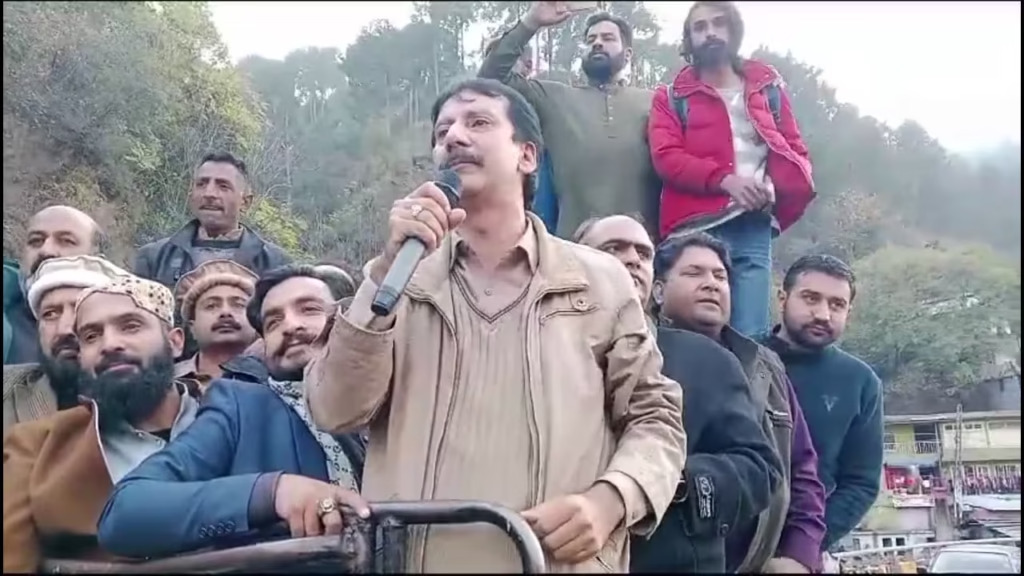
Over the past several years, few public figures have had as significant an impact on politics in Pakistan-administered Jammu and Kashmir (PaJK) as Shoukat Nawaz Mir. From his beginnings as a traders’ representative in Muzaffarabad to becoming the leading face of the Jammu Kashmir Joint Awami Action Committee (JKJAAC), Mir has emerged as one of the most influential voices in the region’s contemporary protest movement.
His leadership has coincided with one of the largest waves of public mobilisation witnessed in Pakistan-administered Jammu and Kashmir in recent decades. What began as demonstrations against inflation, electricity prices and the rising cost of living gradually evolved into a wider movement demanding governance reforms, political accountability and constitutional change.
Early Life and Background
Shoukat Nawaz Mir was born in Muzaffarabad in 1976. Unlike many politicians in the region, his public career did not begin through party politics. He became active through the traders’ community, representing business owners and local markets on issues affecting livelihoods and commerce.
He completed a Bachelor of Commerce (B.Com.) and remained associated with trader organisations for many years, eventually becoming one of the leading figures of the Central Anjuman Tajran Muzaffarabad. During this period, Mir built a reputation as an organiser capable of bringing together different sections of society around economic issues.
From Traders’ Activism to Public Movement
The economic challenges facing Pakistan-administered Jammu and Kashmir—including rising inflation, electricity tariffs linked to Pakistan’s national energy system and increasing costs of basic commodities—created growing public dissatisfaction during the early 2020s.
Initially, traders, transporters, lawyers, labour groups and civil society organisations organised independently. Over time, these groups merged into a single platform that would later become the Jammu Kashmir Joint Awami Action Committee (JKJAAC).
Mir quickly emerged as one of the movement’s most recognisable leaders.
Unlike conventional political parties, the committee presented itself as a non-partisan public movement focused on citizens’ rights rather than electoral politics.
The 2024 Protest Movement
Mir became widely known throughout the region during the 2024 protest movement.
Thousands of people participated in demonstrations demanding:
- Affordable electricity generated from the region’s own rivers.
- Subsidised wheat flour.
- Reductions in government expenditure and official privileges.
- Greater financial transparency.
- Accountability from public institutions.
Following negotiations between protest representatives and the federal government, authorities announced a financial relief package that included reduced electricity charges and subsidies on wheat flour.
The agreement was viewed as one of the movement’s most significant achievements and demonstrated the ability of organised civil action to influence public policy.
Although the immediate economic protests ended, Mir repeatedly argued that deeper structural issues remained unresolved.
Expansion of the Movement
Following the 2024 agreement, the JKJAAC increasingly shifted its focus beyond economic grievances.
Public meetings organised by the committee began addressing broader questions, including:
- Governance reforms.
- Distribution of natural resources.
- Political accountability.
- Constitutional powers of local institutions.
- Public participation in decision-making.
The committee also questioned the continued allocation of reserved seats in the Legislative Assembly for refugees residing in Pakistan, arguing that the issue deserved renewed public debate.
These positions attracted both widespread support and strong criticism across the political spectrum.
Relationship With Authorities
As the movement expanded, relations between the JKJAAC and the regional administration became increasingly strained.
Authorities accused members of the organisation of disrupting public order and later declared the committee a banned organisation under anti-terrorism legislation.
The committee rejected the designation, describing itself as a peaceful public movement representing the interests of the people of Jammu and Kashmir.
Mir has been arrested on multiple occasions during protest campaigns. His supporters describe the arrests as politically motivated attempts to weaken the movement, while authorities maintain that legal action has been taken in response to alleged violations of the law.
Leadership Style
Observers often describe Mir as a consensus builder rather than a traditional party politician.
Rather than relying on a single political organisation, he has worked alongside traders, transport workers, lawyers, students, youth groups and members of civil society.
His speeches have generally centred on economic justice, accountability, transparency and what he describes as the constitutional and democratic rights of the people of Pakistan-administered Jammu and Kashmir.
Supporters credit him with transforming scattered local grievances into a coordinated public movement.
Critics argue that some demonstrations under the committee’s leadership have contributed to instability and disrupted daily life.
Public Influence
Regardless of political opinion, Shoukat Nawaz Mir has become one of the defining public figures in contemporary PaJK politics.
The movement he helped lead has influenced debates on governance, public finance, constitutional arrangements and political representation. Its campaigns have also brought increased international attention to developments within Pakistan-administered Jammu and Kashmir.
Human rights organisations have monitored several phases of the protests, particularly following reports of arrests, restrictions on assembly and the use of force during demonstrations. These developments have further elevated the movement’s profile beyond the region.
Looking Ahead
As Pakistan-administered Jammu and Kashmir approaches another important political period, the future of both Shoukat Nawaz Mir and the JKJAAC remains uncertain.
Despite arrests, legal proceedings and government restrictions, the movement continues to command support among sections of the population. At the same time, the authorities maintain that public order and constitutional processes must be upheld.
Whether remembered primarily as a traders’ leader, a protest organiser or one of the most influential grassroots figures in recent Kashmiri politics, Shoukat Nawaz Mir has become a central figure in the region’s ongoing debate over governance, representation and the political future of Jammu and Kashmir.
Editorial note: This profile focuses on Mir’s public role and activities. Allegations made by authorities remain allegations unless established through due legal process. Kashmiriat is committed to accurate, independently verified reporting that centres the people of Jammu and Kashmir, upholds human rights, and reports developments without adopting the official narratives of any state.
You may also like
-
Bhutto’s Ballot Against Maqbool Butt: Rigging of the 1975 AJK Election
-
Mirwaiz Umar Farooq Urges Dialogue and Restraint Over Unrest in Pakistan-administered Jammu Kashmir
-
Haris Qadeer Biography: Kashmiri Journalist, Editor of Mujadala and Jadojehad
-
47 Most Influential Figures in Jammu & Kashmir History (Ancient to Modern)
-
Indian Government Revokes Professor Nitasha Kaul’s Overseas Citizenship