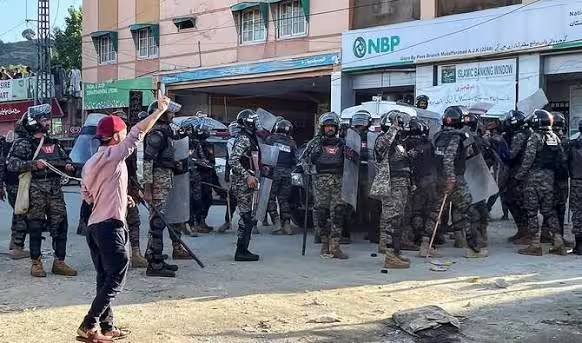
MUZAFFARABAD: The dispute over 12 reserved refugee seats in the Legislative Assembly of Pakistan-administered Jammu Kashmir has become one of the most serious political questions behind the ongoing confrontation between the Jammu Kashmir Joint Awami Action Committee (JAAC) and the authorities.
For JAAC and many residents of AJK, the issue is not only about electoral arithmetic. It is about who has the right to decide the government, cabinet and political future of a territory whose people already live under a limited constitutional framework.
The 12 seats are reserved for Kashmiri refugees from Indian-administered Jammu Kashmir who live across Pakistan. Six seats represent refugees from Jammu and six represent refugees from the Kashmir Valley. In the 2021 elections, voting for these constituencies took place across Pakistan, while the elected members became part of the AJK Legislative Assembly. Dawn reported in 2021 that around 373,652 voters were registered in six Jammu refugee constituencies and 29,804 voters in six Kashmir Valley refugee constituencies.
Why JAAC Opposes the Seats
JAAC argues that the 12 seats allow people who do not live in AJK to influence the formation of government inside AJK. Protesters say residents of AJK directly face the consequences of local governance: electricity prices, flour shortages, police action, roads, hospitals, schools, taxes, jobs and development funds.
The committee’s argument is that those who live under the government should have decisive control over who forms that government.
This concern has become more serious because 12 seats can significantly affect the balance of power in a 45-seat directly elected assembly. In close contests, these seats can help determine which party forms government, who becomes prime minister, and which groups receive ministries.
The available 2021 constituency-wise results show that several refugee-seat candidates won with very small vote totals compared with many territorial constituencies inside AJK, yet some later held cabinet or senior assembly positions. The 2021 election table records results for LA-34 to LA-45, covering the 12 refugee constituencies.
| Constituency | Seat category | Winning candidate | Party in 2021 | Votes secured | Later office / portfolio verified from public reporting |
|---|---|---|---|---|---|
| LA-34 | Jammu & Others | Riaz Ahmed Gujjar | PTI | 4,320 | Deputy Speaker of AJK Legislative Assembly; elected with 32 votes in the Assembly. |
| LA-35 | Jammu & Others | Maqbool Ahmed Gujjar | PTI | 18,934 | No cabinet portfolio verified in the cited 2023 portfolio list. |
| LA-36 | Jammu & Others | Hafiz Hamid Raza | PTI | 22,096 | Adviser for Auqaf / religious endowments was reported in official news coverage. |
| LA-37 | Jammu & Others | Muhammad Akmal Sargala | PTI | 26,039 | Minister for Forestry. |
| LA-38 | Jammu & Others | Muhammad Akbar Chaudhry / Chaudhry Akbar Ibrahim | PTI | 14,283 | Minister for Food. |
| LA-39 | Jammu & Others | Raja Muhammad Siddique | PML-N | 9,557 | Minister for Industry, Commerce, Labour, Welfare, Weights and Measures, Silk and Printing Press. |
| LA-40 | Kashmir Valley | Aamir Abdul Ghaffar Lone | PPP | 2,165 | Minister for Environment. |
| LA-41 | Kashmir Valley | Ghulam Mohi-ud-Din Diwan | PTI | 2,326 | No cabinet portfolio verified in the cited 2023 portfolio list. |
| LA-42 | Kashmir Valley | Muhammad Asim Sharif | PTI | 1,254 | Minister for Sports, Youth and Culture; later his State Subject certificate was cancelled by the cabinet after an inquiry declared it invalid. |
| LA-43 | Kashmir Valley | Javed Butt | PTI | 782 | Minister for Transport. |
| LA-44 | Kashmir Valley | Muhammad Ahmad Raza Qadri | PML-N | 2,027 | Minister for Religious Affairs and Endowments. |
| LA-45 | Kashmir Valley | Abdul Majid Khan | PTI | 3,138 | Minister for Finance and Mutual Aid. |
Why These Numbers Matter
The data is central to JAAC’s argument.
Several members elected from refugee constituencies received only a few thousand votes, and in some cases fewer than 3,000 votes, but later became ministers responsible for departments affecting people living inside AJK. For example, the 2021 table records 782 votes for Javed Butt in LA-43, 1,254 votes for Muhammad Asim Sharif in LA-42, 2,027 votes for Muhammad Ahmad Raza Qadri in LA-44, 2,165 votes for Aamir Abdul Ghaffar Lone in LA-40, and 2,326 votes for Ghulam Mohi-ud-Din Diwan in LA-41.
By comparison, many territorial constituencies inside AJK have much larger electorates and far higher vote totals. This has strengthened the perception among JAAC supporters that the political weight of residents inside AJK is diluted by constituencies located outside the territory.
For protesters, the question is straightforward: how can a member elected from outside AJK, sometimes with a small number of votes, become a minister and make decisions over departments that govern the lives of AJK residents?
Government and Refugee Representatives’ Position
The government and refugee-seat representatives reject JAAC’s demand as unconstitutional and harmful to displaced Kashmiri communities. Their argument is that the refugee seats represent families displaced from Jammu and Kashmir after 1947 and later phases of the conflict, and that these communities remain part of the wider Jammu Kashmir political question.
The Supreme Court of AJK ruled in June 2026 that the 12 refugee seats are constitutionally protected and cannot be abolished without a constitutional amendment. The court also said elections must be held within the constitutionally prescribed period and that unresolved constitutional questions should be addressed by the Legislative Assembly.
The government has used this ruling to argue that it cannot abolish the seats through executive order. Prime Minister Faisal Mumtaz Rathore has maintained that most JAAC demands were accepted, while the remaining issues relate to constitutional provisions that only the Assembly can change.
Refugee-seat ministers have strongly opposed the JAAC demand. In October 2025, Finance Minister Abdul Majid Khan, Food Minister Chaudhry Akbar Ibrahim and Sports Minister Asim Sharif Butt resigned from the AJK cabinet, saying the government had failed to safeguard the constitutional rights of Kashmiri refugees. Dawn reported that all three were elected on PTI tickets from refugee constituencies and later joined the forward bloc led by Chaudhry Anwarul Haq.
JAAC’s Core Objection
JAAC’s objection is not that displaced Kashmiris have no political identity. Its central objection is that non-resident constituencies should not be able to decide the government of a territory where the voters do not live and where they do not directly face the consequences of governance.
The issue has therefore become a larger debate over democratic consent.
For residents of AJK, the 12 seats affect:
- formation of government;
- appointment of ministers;
- distribution of development funds;
- cabinet balance;
- voting on constitutional and legislative matters;
- and the political weight of people living inside the territory.
This is why the demand has moved from a technical electoral issue to one of the central questions of the JAAC movement.
A Question Beyond Numbers
The controversy also became more sensitive after the AJK cabinet cancelled the State Subject certificate of Muhammad Asim Sharif Butt, who was elected from LA-42 Kashmir Valley-III. Dawn reported that the certificate had been challenged and that an inquiry concluded it was invalid. The cabinet later approved its cancellation.
For JAAC supporters, the case reinforced concerns over verification, eligibility and accountability in refugee constituencies. For refugee-seat defenders, the broader campaign against the seats remains an attack on displaced Kashmiri political rights.
The dispute now sits at the heart of AJK’s political crisis: how should displaced Kashmiris be represented without weakening the democratic rights of people living inside AJK?
Until that question is resolved through transparent dialogue, constitutional clarity and public consent, the refugee seats issue is likely to remain a recurring flashpoint in Pakistan-administered Jammu Kashmir.
You may also like
-
Shaukat Nawaz Mir Yet to Be Produced Before Court, Family Denied Access Since Arrest, JKJAAC Says
-
PML-N Leads PaJK Elections Amid Boycott, Rigging Allegations, Violence and Major Political Upsets
-
Muzaffarabad Shuts Down as Clashes and Roadblocks Disrupt Election-Day Movement
-
Civilian Death Toll in PaJK Protests Rises Above 87 as Two More Killed
-
At Least 37 Civilians Killed by Pakistani Security Forces in PaJK in Two Days