For more than seven decades, the Kashmir dispute has largely been presented to the world as a binary contest: India or Pakistan.
Textbooks, diplomatic communiqués, and countless political speeches have framed the conflict around competing claims of two nuclear-armed neighbours. Lost in that narrative is a question that once occupied the minds of diplomats, United Nations officials and, according to newly examined archival records, one of Kashmir’s most influential political leaders:
What if Kashmir were neither?
A declassified U.S. diplomatic cable, sent from New Delhi to Washington on 29 September 1950, offers a remarkable window into that forgotten debate.
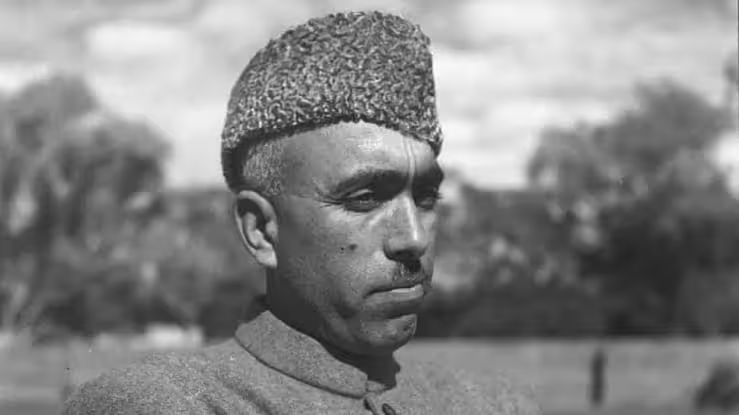
The document, Telegram No. 799, preserved in the U.S. Department of State’s Foreign Relations of the United States (FRUS) series, records two confidential meetings between Loy W. Henderson, the United States Ambassador to India, and Sheikh Mohammad Abdullah, then the Prime Minister of Jammu and Kashmir and the dominant figure in the state’s post-Partition politics.
Unlike public speeches, political manifestos or newspaper interviews, the conversations described in the cable took place behind closed doors. Henderson makes clear that the meetings occurred at Abdullah’s own request and were treated as confidential diplomatic exchanges. They were never intended for public consumption.
What emerged from those discussions differs in important ways from the simplified narratives that have come to dominate later histories of the Kashmir dispute.
A Private Position, Not a Public Speech
According to Ambassador Henderson’s account, Sheikh Abdullah argued “strongly” that Kashmir should become an independent country.
The ambassador further recorded Abdullah’s belief that a substantial majority of the people of Jammu and Kashmir desired independence rather than accession to either India or Pakistan. Abdullah also questioned why the United Nations, then actively engaged in seeking a settlement to the dispute, had not seriously considered independence as a possible political outcome.
Whether Abdullah’s assessment accurately reflected public opinion in 1950 cannot be determined from the cable alone. The document records his private political judgment, not the findings of a referendum or public survey. Yet its historical significance lies precisely in showing that independence was being advocated at the highest political level during the formative years of the dispute.
The cable also reveals that Abdullah rejected proposals advanced by United Nations representative Sir Owen Dixon, who had explored various partition and regional plebiscite formulas. According to Henderson’s report, Abdullah warned that dividing Jammu and Kashmir would fracture families, sever cultural and economic ties, and create enduring instability.
More Than a Territorial Question
The Henderson cable portrays Abdullah as arguing that Kashmir’s future could not be understood solely through the competing territorial claims of India and Pakistan.
Instead, he emphasised Kashmir’s distinct historical and cultural identity. According to the ambassador’s report, Abdullah argued that Kashmiri Hindus and Kashmiri Muslims shared social and historical characteristics that distinguished them from communities elsewhere in India and Pakistan.
His vision of independence was not one of isolation. Henderson recorded Abdullah as saying that an independent Kashmir would require peaceful relations with both neighbours and international economic assistance if it were to survive.
That vision reflected an attempt to imagine Kashmir not as a frontier between rival states, but as a political entity capable of maintaining relationships with both.
The “Third Option” in Diplomatic History
One of the most intriguing passages in Henderson’s report concerns the views of foreign officials already present in Kashmir.
The ambassador wrote that many international observers believed the population of the Kashmir Valley might favour Pakistan if offered only a choice between India and Pakistan. At the same time, he noted that many of those same observers believed an independence option could attract broader support if it were available.
This was not evidence from a referendum, nor did Henderson present it as such. Rather, it reflected the impressions of diplomats and military observers working in Kashmir during one of the earliest phases of the international dispute.
Even so, the passage demonstrates that independence was not viewed as an implausible or fringe idea within diplomatic circles in 1950. It was discussed, considered and recorded in official communications between governments.
Reading the Archive Carefully
Historical documents rarely settle political disputes, and this cable is no exception.
It does not prove what all communities across the former princely State of Jammu and Kashmir wanted in 1950. Nor does it establish what they would choose today. Historical opinion cannot simply be projected onto the present.
What the document does establish is narrower, but historically important.
It shows that one of Kashmir’s foremost political leaders privately urged an American ambassador to consider independence as the preferred political future for the region. It also shows that the idea formed part of international diplomatic conversations during a period when the United Nations was actively seeking a settlement.
In that sense, the cable complicates the common assumption that the dispute was always understood internationally as a simple choice between accession to India or accession to Pakistan.
Why the Document Still Matters
The Kashmir dispute remains unresolved more than seventy-five years after Partition. Competing constitutional claims, changing political realities, armed conflict, and decades of mistrust have reshaped the region in ways that few diplomats in 1950 could have anticipated.
Yet archival documents such as Henderson’s cable remind historians that the political imagination of the period was more varied than later narratives often suggest.
The declassified cable does not answer the question of Kashmir’s future.
But it does recover a part of its past, one in which independence was not merely the subject of later political movements, but a proposal articulated privately by Kashmir’s most influential leader and recorded in the official diplomatic archives of the United States.
Sometimes history’s greatest revelations are not found in what governments chose to say publicly, but in what they quietly wrote to one another behind closed doors.
You may also like
-
The National Liberation Front: Origins of the Organised Armed Struggle for an Independent Kashmir
-
JAAC Revives Muzaffarabad Long March After Talks End Without Agreement
-
Talks Make Progress but No Written Agreement Yet, JAAC Leader Warns Long March Could Be Announced Within Hours
-
Muzaffarabad: The Complete History of Jammu Kashmir’s River Capital
-
Public Opinion in Pakistan-Administered Jammu & Kashmir, the Demand for Independence